The Hemp Ban Hands Licensed Cannabis Its Stickiest Customer. New York's Drink Shelf Is Already Up 33% in Units.
For three summers, the easiest way to try THC in America has been a can.
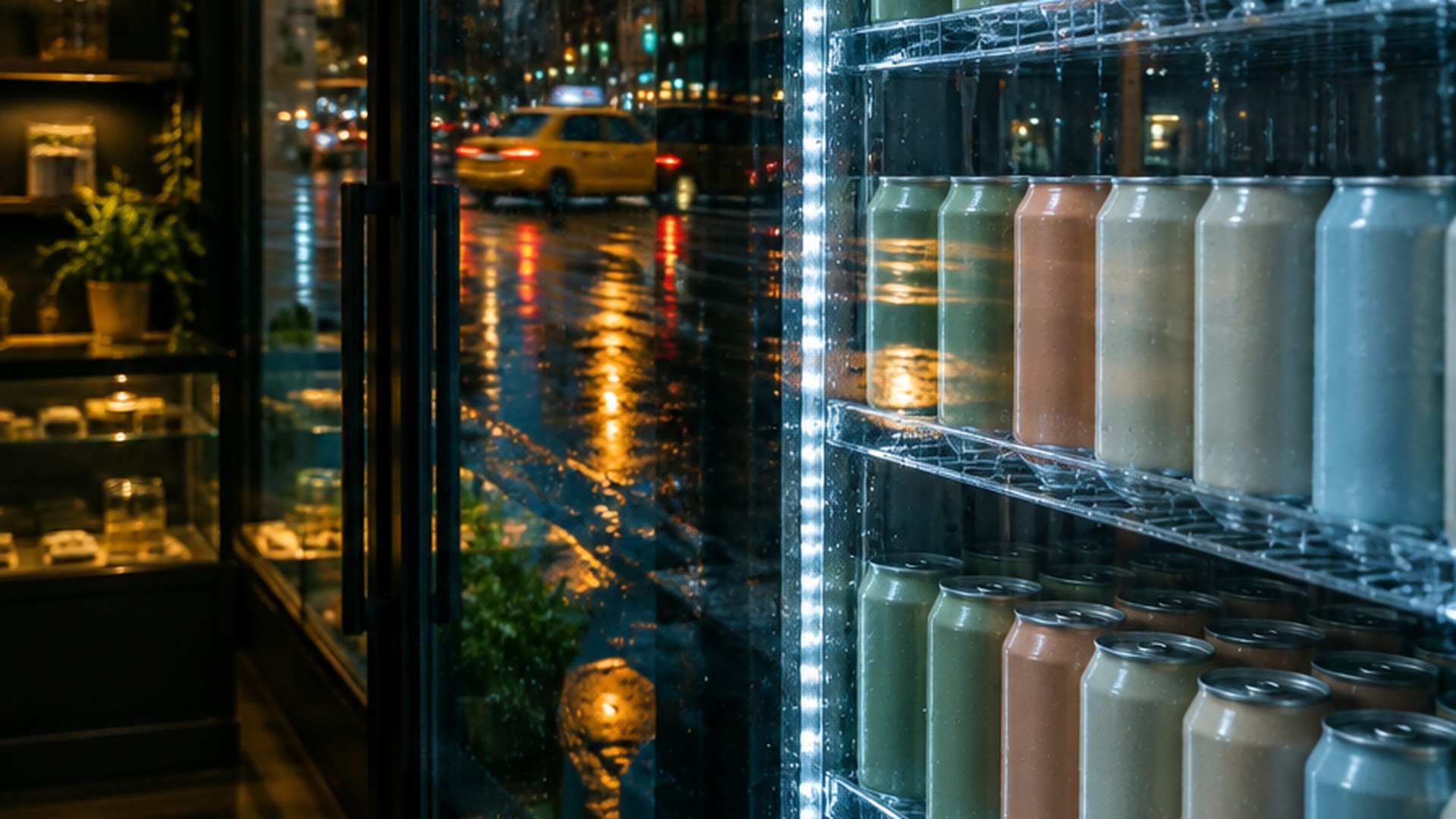
For three summers, the easiest way to try THC in America has been a can. Not a joint, not a gummy bought from behind a security guard, but a seltzer in a liquor-store cooler next to the hard kombucha, five or ten milligrams a pop, sold to anyone with a driver's license.
That era ends December 11, when the federal definition of hemp narrows to finished products containing no more than 0.4 milligrams of total THC per container. A 10-milligram seltzer is 25 times over the line. The drinks go dark unless Congress moves again, and the people who bought them, most of whom have never set foot in a dispensary, go looking for a replacement.
In New York, the replacement already exists. It is a small shelf, and it is growing faster than anything else in the store.
The category cannabis gave away
When ATB Cormark surveyed 17 institutional cannabis investors in late September, respondents put the odds of the hemp ban actually taking effect at 58 percent, even though it is already law. Frederico Gomes, ATB's director of institutional equity research, told Forbes investors are underestimating it because they are only now grasping the size of what hemp became: by his estimate more than $30 billion a year, as large as or larger than the entire state-licensed market. Beau Whitney of Whitney Economics puts the revenue at risk at $28.3 billion and expects much of it to go online or illicit rather than into dispensaries.
On drinks, the two mostly agree. Gomes said beverages live in their own consumer ecosystem, sold through liquor and grocery channels licensed cannabis never reached. Whitney was blunter: the marijuana industry "has basically capitulated the THC beverage market to hemp."
The numbers say he is right. Hemp-derived THC drinks did $239 million in tracked mainstream retail in the 52 weeks ending April 4, according to NielsenIQ data reported by Forbes. Liquor stores moved about $132 million of that. Convenience stores did $55 million and were growing faster than liquor; grocery was close behind at $49 million. Ten-milligram drinks were 51 percent of category dollars. Five-milligram cans were another 22 percent.
For comparison, licensed dispensaries in the 16 state markets Headset tracks sold $299 million of beverages in the 12 months to September, per Headset, about 1.2 percent of tracked cannabis sales. The hemp channel built a drink business nearly the size of the entire regulated one, in liquor, convenience and grocery stores, in three years.
Hoodie Analytics, which tracks beverage-alcohol stores daily, counted $66 million in hemp drink sales across 585 tracked stores in the 13 weeks to September 26, about $5 million a week in a sample of seven chains. Texas, with no adult-use market, had the most stores carrying them. Florida, medical-only, was second. In Minnesota, where hemp drinks have been in liquor stores since 2022, THC beverages approach 10 percent of sales at some of the state's largest liquor retailers. That is what the category looks like when it is allowed to sit next to beer.
New York's shelf was built for this
New York never let the hemp drink boom in the front door. The state's cannabinoid hemp rules cap beverages sold outside dispensaries at 1 milligram of THC per serving with a mandatory 15-to-1 CBD-to-THC ratio, a product almost nobody wants. The 5- and 10-milligram can filling coolers in Texas and Minnesota was, in New York, only legal inside a licensed store.
For three years that was a handicap. It is about to become the whole point, because the shelf it forced into existence looks exactly like the one hemp built elsewhere.
Licensed New York dispensaries sold $2.51 million of drinks in September, about 1.56 percent of the $160.8 million Headset tracked statewide that month. That is above the national dispensary average of 1.2 percent. Sales were up 16.2 percent year over year. Units were up 32.6 percent, to roughly 490,000 cans, and the average price held at $5.12. In a state where OCM's average price per item fell 8.1 percent between January and September, drinks are one of the few formats where the price is flat and the volume is doing the work.
Four of the five largest segments grew by double digits:
| Segment | Sept 2026 sales | Units | YoY sales growth |
|---|---|---|---|
| Iced tea, lemonade and fruit | $0.73M | 153,953 | +21.5% |
| Carbonated | $0.72M | 154,967 | +18.3% |
| Water | $0.48M | 99,380 | −6.3% |
| Mocktails | $0.24M | 45,522 | +18.4% |
| Tea, coffee and hot cocoa | $0.14M | 24,818 | +112.5% |
| Sports and energy | $0.12M | 8,722 | +309.3% |
Source: Headset, New York, September 2026.
The format that wins is the one hemp proved: a single 12-ounce can, 10 milligrams, about $5, in a flavor you already drink. Iced tea, lemonade and seltzer are nearly 60 percent of the category. Sports drinks and hot beverages are small but doubling and quadrupling. The one segment shrinking is infused water, the original "cannabis drink" of 2023, which is losing ground to products that taste like something.
Eight brands have a meaningful share, which is unusual in a New York category. Ayrloom, the Beak & Skiff apple-orchard brand, holds a little over half. Behind it, the growth belongs to the field: Layup, the 10-milligram tea-and-lemonade line co-founded by former Knick J.R. Smith, is No. 2 and up 33.7 percent year over year; Harney Brothers Cannabis, which now puts nearly two-thirds of its business into drinks, is No. 3 on growth above 150 percent; High Peaks, Tune, Weed Water, Cycling Frog and Cannabis Quencher round out the list. Across the river, New Jersey's beverage shelf is moving the same way: Journeyman is up 53 percent, and Cantrip, a hemp seltzer brand that told the trade press in 2024 it had stopped producing for dispensaries entirely, is up more than tenfold inside them.
What ties these products together is that they look, taste and dose like the hemp drinks about to vanish from a liquor store in Texas. Same 10-milligram serving. Same raspberry tea and limeade. Same can. The difference is a state-licensed lab test, seed-to-shelf tracking, and an ID check at the counter.
The stickiest customer in cannabis
The beverage customer is worth more than the can suggests. Headset's loyalty data shows beverage brands retain about 61 percent of their category customers over time. Pre-roll brands keep 31 percent. A drinker who finds a can they like keeps buying it, a few at a time, often, without comparison-shopping THC per dollar.
That is a different consumer from the one licensed cannabis has spent a decade fighting over. The flower customer is price-sensitive, potency-driven, and willing to go back to a plug when dispensary prices rise. The beverage customer is, in many cases, someone who was never in the market at all: the person who stopped at two glasses of wine and now stops at one can. Headset's California report says drinks are "capturing new consumers and occasions," and its data shows products at 10 milligrams or less gaining share in the Northeast, led by New York, where they are 87.8 percent of beverage sales.
Dispensaries have been slow to merchandise for that person. The can sits in a cooler by the register, if there is a cooler at all. The hemp channel put it at eye level next to the seltzer. When that channel closes, the dispensary inherits the customer without inheriting the shelf placement, and the brands that figured out cold, single-can, grab-and-go merchandising will take the lift.
What Albany does next
The missing piece is distribution. A $5 dispensary can is competitive with anything in a liquor cooler, but New York has roughly 700 licensed stores open and none of them is the bodega on the corner.
State Senator Jeremy Cooney and Assemblymember John Zaccaro introduced companion bills in February that would let licensed liquor and wine stores obtain a permit to sell cannabis drinks of up to 5 milligrams of THC, kept in a separate, marked section under joint oversight from the State Liquor Authority and the Office of Cannabis Management. The bills remain in committee. New Jersey moved this year to restrict intoxicating hemp drinks to liquor stores and licensed dispensaries ahead of a state cutoff now set for November 13 that pending bills would push to December 11. In Washington, Representatives Beth Van Duyne of Texas and Greg Landsman of Ohio filed a bill in August to carve beverages out of the federal ban entirely and regulate them like alcohol, with a 5-milligram serving cap and an excise tax of 8 cents per milligram. It, too, is in committee.
Ohio offers the closest preview of what happens when hemp goes dark in a state with a licensed market. Ohio barred most intoxicating hemp products in March; September cannabis sales there hit $116.8 million, up 33.2 percent, the largest gain of any adult-use state Headset tracks. Gomes called the hemp ban an important contributor. Forbes points to Ohio's young market and high prices as other drivers, and a federal injunction has let some hemp sellers keep operating. How much of the lift belongs to the ban is not settled.
But the direction is not in dispute. When hemp disappears in a state that has a licensed market, some of the demand walks into the dispensary. When the product is a drink, low dose, familiar flavor, sold to people who were never going to buy an eighth, the walk is shorter.
New York spent three years losing the beverage customer to a liquor store in another state. Starting December 11, its 1.5 percent shelf may be the only place that customer can legally buy the can.
Sources
- Javier Hasse, "The Hemp Ban Could Send Billions To Licensed Cannabis. One Analyst Says Investors Are Missing It," Forbes, Oct. 8, 2026
- ATB Cormark Capital Markets, Fall 2026 Cannabis Investor Sentiment Survey
- Headset, New York Cannabis Sales, September 2026 (beverage totals, segment table, brand list)
- Headset, Cannabis Industry Statistics 2026 (US beverage $299M / 1.2% share; retention 60.7% vs 30.9%)
- Headset, Tune brand page (Layup +33.7%, Harney +152.8%, Ayrloom −2.0%)
- Headset, Cantrip brand page (NJ: Journeyman +52.95%, Cantrip +926%)
- Headset, California market page ("capturing new consumers and occasions")
- Noel Burgess, "THC Drinks Face A Federal Deadline That Could Upend The Market," Forbes, July 20, 2026 (NielsenIQ: $239M, +135%, alcohol −3.3%, liquor $132M / convenience $55M / grocery $49M, 10 mg 51% / 5 mg 22%)
- Hoodie Analytics, National Hemp Beverage Market Data ($66M / 585 stores / 13 weeks; Texas, Florida store counts)
- MN Cannabis Hub, "Minnesota's THC Beverage Boom" (≈10% of liquor-store sales)
- Vicente LLP, "Federal Hemp Update: Definition Change Delayed to December 11
- Hemp Law Group, federal hemp bills tracker (Landsman beverage bill)
- Hoodline, "New York Cracks Down on Unlicensed Cannabis Drinks" (1 mg/serving, 15:1 ratio; NJ restrictions)
- Marijuana Moment / Duane Morris on S9220 / A10191
- Marijuana Moment / Duane Morris on S9220 / A10191 (2)
- Greenway Magazine, "How ayrloom became New York's best-selling cannabis brand" (Beak & Skiff)
- Gotham NYC brand page, Layup (J.R. Smith co-founder)
- Shanken News Daily, "Cannabis Beverage Brand Cantrip Looks To Double Its Footprint This Year," Mar. 19, 2024 (hemp seltzer, Minnesota launch Sept 2022, stopped producing for dispensaries)
- Kind Green Buds trends summary citing Headset (≤10 mg products gaining share in the Northeast)
- NielsenIQ via BevNET, "NIQ: THC beverages hit $239M in mainstream retail" (52 weeks ending April 4, 2026)
- Headset, "Sessionable or just displaced? What's actually driving low-dose cannabis beverages"
- Wine & Spirits Wholesalers of America, Beverage Regulatory Parity Act (Van Duyne and Landsman)