Research /Research
Out-of-State Money Owns Two-Thirds of Florida’s Weed Stores. The Locals Still Sell More.
Cookies, Jungle Boys, STIIIZY, Cresco, MedMen: how outsiders bought their way into America’s biggest medical-only cannabis market — and why the Florida operators are beating them at the counter.
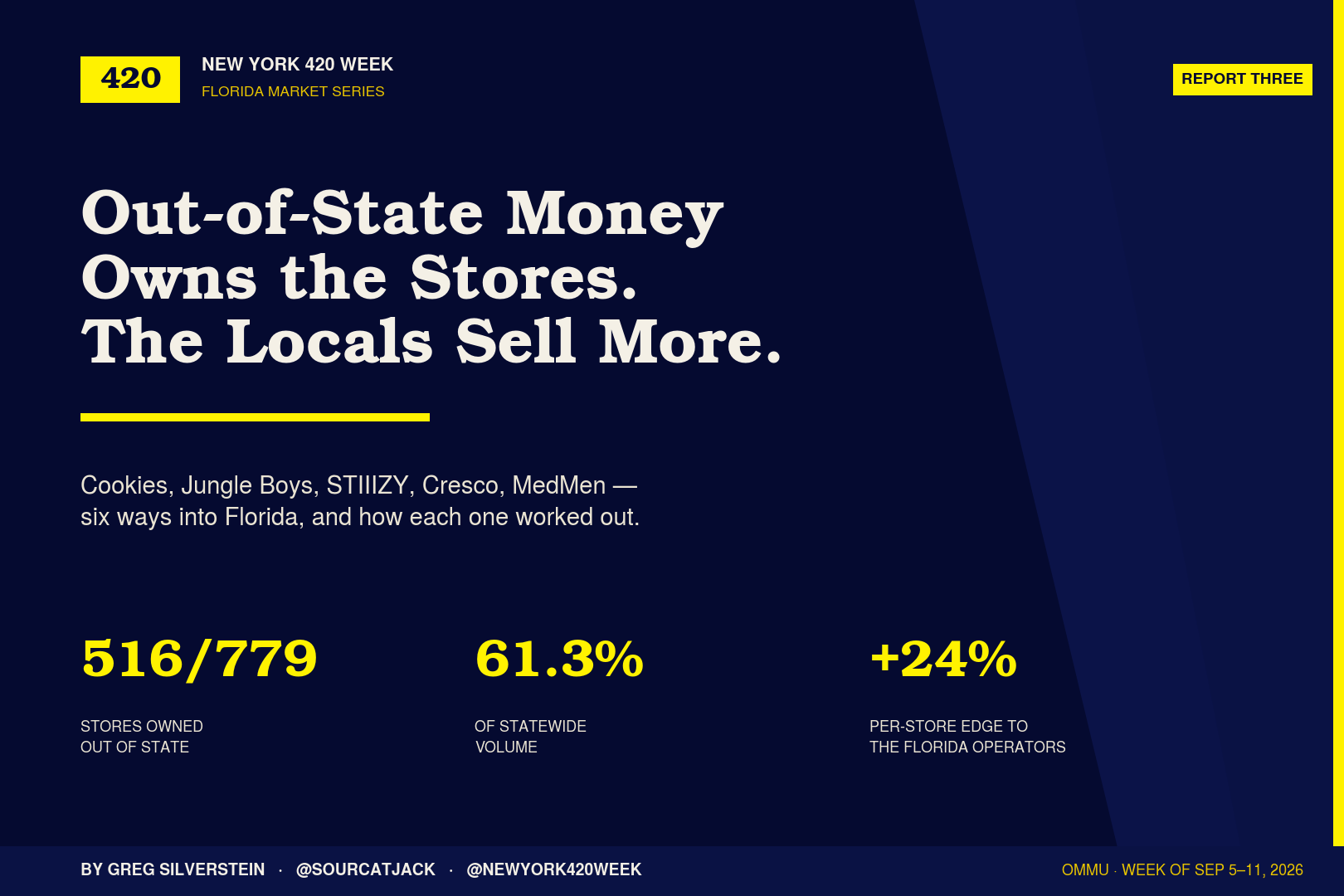
You cannot open a cannabis store in Florida. The statute does not permit it. Every licence is vertically integrated — the same company must cultivate, process and dispense — and for most of the past decade there were only 22 of them in a state of 23 million people.
So if you are a California brand or an Illinois multi-state operator and you want in, you have four options: buy a company that already holds a licence, license your name to one, take one from a lender, or win one and wait three and a half years.
They have tried all four. Here is how it went.
The scoreboard
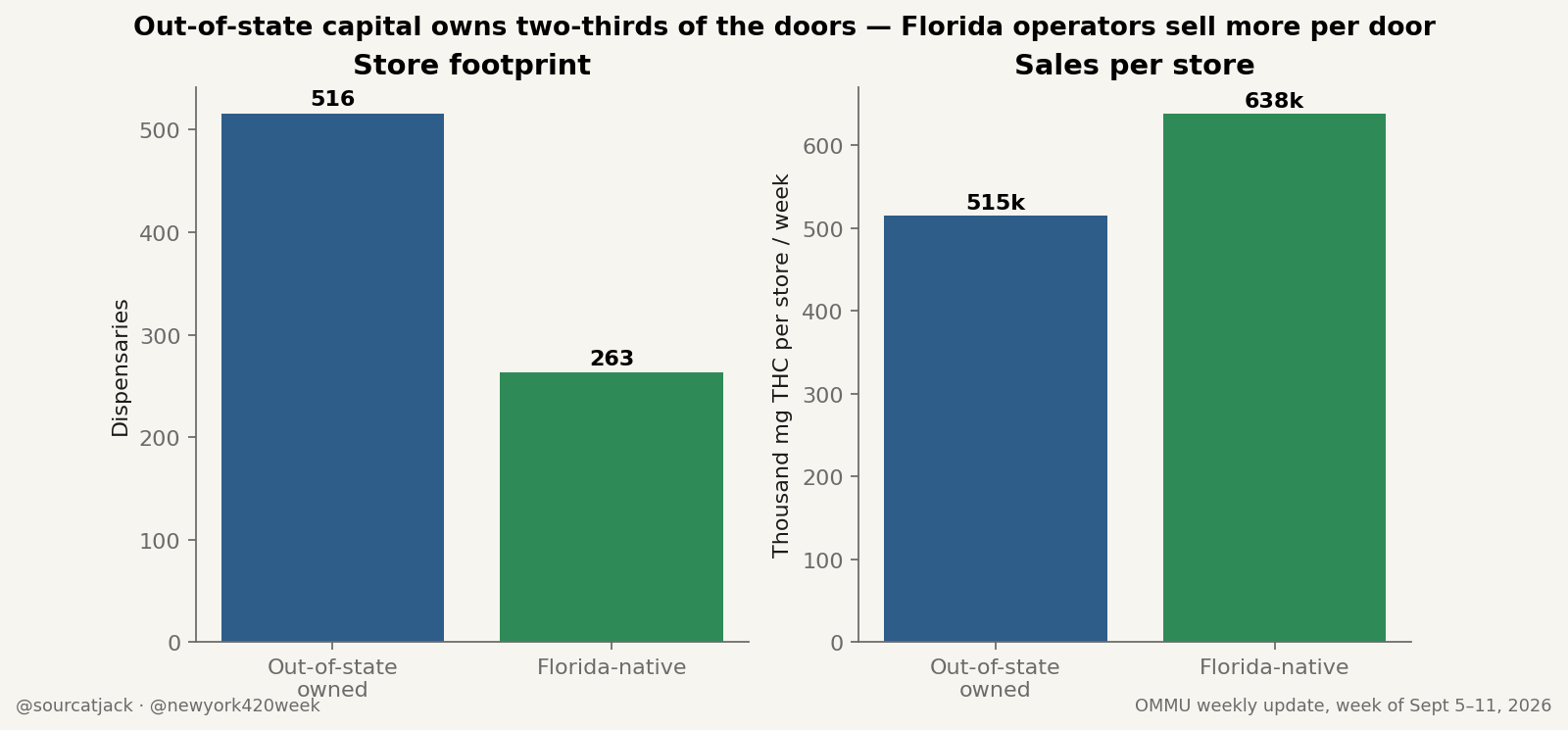
Out-of-state parents control 516 of Florida’s 779 dispensaries and 61.3% of everything dispensed in the state. On footprint, the outsiders won decisively.
A note on the counting: this splits the 779 stores by where the parent company is from, not by who owns them. FLUENT’s 33 stores count as Florida-native here because Cansortium is a Florida company; Vireo’s pending purchase would move them out of state and take the out-of-state figure to 549 stores and 66.2% of volume. Our companion piece groups the same stores by owner instead, and that Vireo bucket already sits inside the 516 — the two counts answer different questions and cannot be added.
On the measure that matters at the counter, they did not. Florida-native operators move 638,000 milligrams of THC per store per week; out-of-state-owned stores move 515,000. That is a 24% advantage to the home team.
The reason is composition. The native cohort includes Trulieve, founded in Quincy and still the market leader, plus Sunburn, Goldflower and The Flowery — operators built around Florida cultivation and, in the craft cases, genuine scarcity pricing. The out-of-state cohort is heavy with the mid-tier chains that were assembled by acquisition and are now being resold: Surterra, Planet 13, Sunnyside, Mint.
Capital bought the footprint. The Florida companies built the demand.
Six ways in, ranked by how they worked out
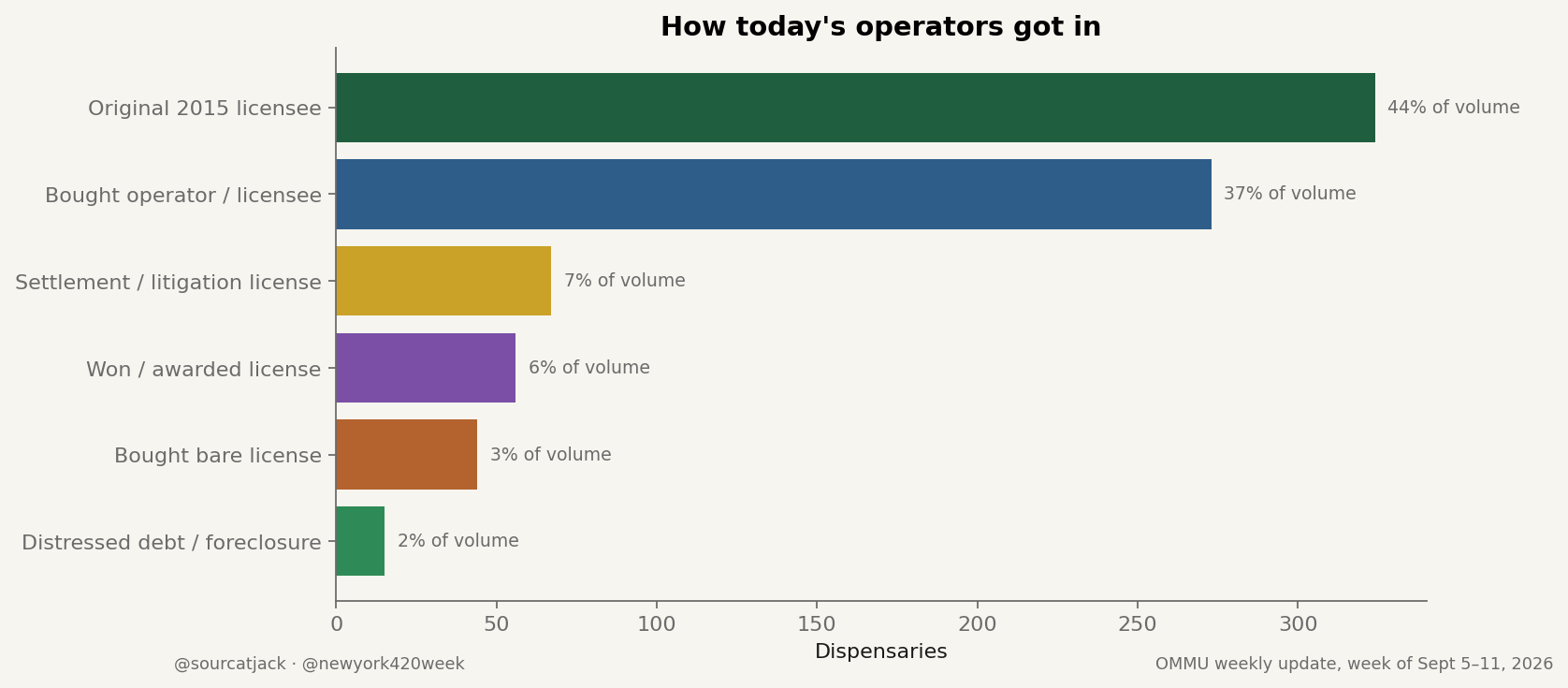
1. Buy an operating licensee — the only route that reliably worked. The four largest out-of-state positions in Florida were all built this way. Cresco paid $213 million for Bluma Wellness in April 2021 and got cultivation, retail and delivery already running; it still operates 31 stores as Sunnyside. Ayr paid roughly $290 million for Liberty Health Sciences. Green Thumb paid $98.2 million for KSGNF in 2018 — six stores and a Homestead grow — and today runs the most productive doors in the state at about 895,000 milligrams each. Verano absorbed AltMed and now runs 86 stores.
2. Distressed debt — the cheapest door, and the 2026 norm. Green Growth Brands of Ohio paid $54.65 million for the Spring Oaks licence in August 2019, entered Canadian insolvency nine months later, and lost the licence to its own secured creditor — Green Ops Group of Columbus, approved by Florida in December 2020 and operating it today as Jungle Boys. That template is now standard. SNDL took Surterra out of Parallel’s roughly $842 million of debt by strict foreclosure in July 2026. Vireo is taking FLUENT partly by converting $30 million of debt to equity. In 2026 the buyers of Florida cannabis assets are lenders.
3. Buy a bare licence — expensive optionality nobody converted. Planet 13 paid Harvest $55 million in 2021 for a licence with no stores and no revenue. It never built the business, bought VidaCann’s 26-store chain instead for about $48.9 million, and sold the original licence for $9 million. The buyer, Colorado’s Fino, opened its first store in Clermont in June 2026 and says it is targeting roughly fifteen profitable stores — not fifty. A licence is not a business, and in Florida the gap between the two is a cultivation facility.
4. Brand licensing without the licence — the trap. More on this below.
5. Win one in a batching cycle — slowest of all. STIIIZY, Theory Wellness, Star Buds, Klutch, Greenlight and Belushi’s Farm all applied in April 2023 and received licences on 11 September 2026. Each now owes a $5 million bond and must request dispensing authorisation within a year. Not one has sold a gram.
6. Be one of the original five. Only Curaleaf remains from the 2015 cohort under out-of-state ownership.
MedMen: the cautionary tale
MedMen bought the Treadwell licence in 2018, built fourteen stores and a 30,000 sq ft grow, and announced its Florida exit at $83 million in February 2022. It closed in August at $63 million in cash plus $4 million of assumed liabilities — $16 million below the announced price.
The buyer was Green Sentry Holdings, run by Florida’s Brady Cobb, which rebranded the business Sunburn. Today those same fifteen stores move about 875,000 milligrams each, among the highest in the state.
Same licence. Same stores. Different operator. Transformed result. It is the single cleanest demonstration that in Florida the constraint is operating competence, not access.
Cookies doesn’t own its Florida stores
Cookies never bought a Florida licence. TRP Co., a Los Angeles group, acquired the dormant Tree King-Tree Farm licence in September 2020 and operates the stores. Cookies licenses the brand for a royalty and holds an option to buy the assets.
The royalties stopped in 2021. Cookies won a $22.7 million arbitration award against the operator, said in 2024 it would exercise its purchase option, and as of late 2025 no closing had been reported — while Cookies itself faced a separate $8.4 million judgment in San Francisco.
Nineteen Florida dispensaries carry the name of a company that is suing to control them. Jungle Boys’ arrangement with its Ohio licence-holder appears more stable but is equally opaque. In both cases the licence holder, not the brand, holds the power — which is the structural lesson for any brand considering the same route.
The graveyard
MedMen (California) exited in 2022 at $63 million. Columbia Care / Cannabist (New York) exited in November 2024, selling fourteen dispensaries and two production facilities for $5 million. Harvest Health (Arizona) never operated its Florida licence, divesting it as a merger condition. Green Growth Brands (Ohio) paid $54.65 million and lost the licence to creditors. Green Peak Innovations (Michigan) agreed to pay $48 million for the Tree King licence in 2019 and never closed.
And a long list never came at all: 4Front, Ascend Wellness, TerrAscend, Jushi, MariMed, PharmaCann, Schwazze, Glass House, Grown Rogue, C3 Industries. Whether any of them applied in the 2023 cycle is not something we could confirm.
Four lessons
A licence is not a business. Every buyer of bare paper — Planet 13 at $55 million, Green Peak’s aborted $48 million, Green Growth’s $54.65 million — lost money or lost the licence. Every buyer of a running operator is still operating.
Brand equity does not travel without control. Cookies and Jungle Boys are two of the strongest names in American cannabis. One is litigating against its Florida licensee; the other is run by an Ohio creditor.
The next wave is credit, not cash. Vireo will hold roughly 108 Florida stores — the second-largest footprint in the state — assembled from three distressed or semi-distressed chains without paying a headline cash price for any of them.
The locals out-sell the buyers. 638,000 milligrams per store against 515,000. Whatever out-of-state capital bought, it was not per-door performance.
The twenty-two licensees who received paper on 11 September now have to build cultivation from scratch, on a deadline, into a patient base that has stopped growing and prices among the lowest in the country. They are inheriting the hardest version of this market — and on the record above, the ones most likely to make it work are whoever ends up actually running the stores.
Methodology: store counts, volumes and sales-per-store from the OMMU weekly dispensation table for September 5–11, 2026. Owner nationality assigned by the parent company’s headquarters, not by where the licence was issued. Deal values are as disclosed by the parties; where a Florida-attributable figure was never broken out of a larger multi-state transaction, it is marked undisclosed rather than estimated. By Greg Silverstein · @sourcatjack · @newyork420week.