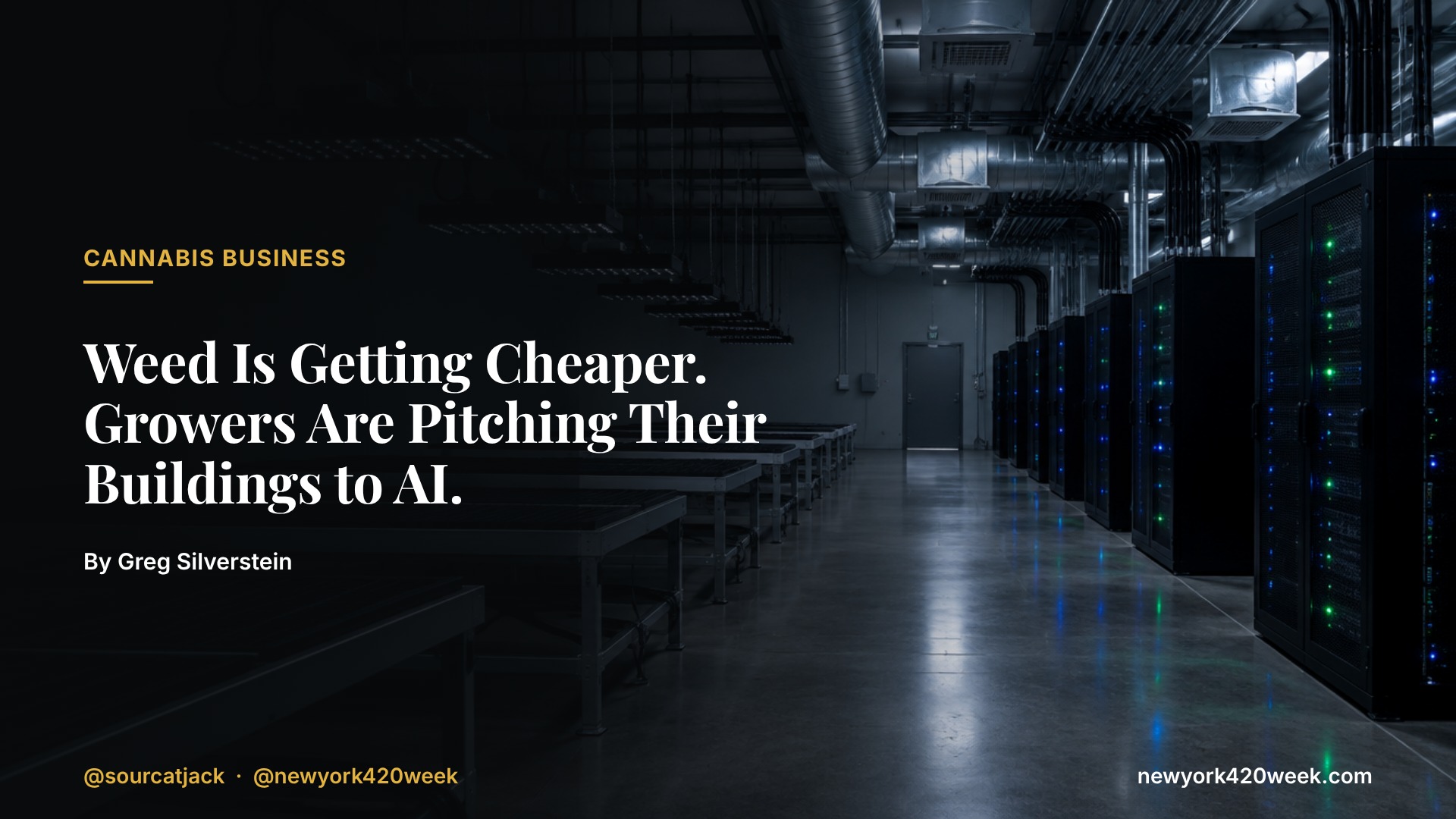
Weed Is Getting Cheaper. Growers Are Pitching Their Buildings to AI.
Why struggling cultivators are listing grow rooms as data centers, and why I couldn't find one that has closed
Michael Ward built a cannabis facility in Kalamazoo, Michigan for about $20 million in 2020. Back then, a pound of weed sold for roughly $2,500. Today, he says, it goes for about $700. So this summer he did something that would have sounded ridiculous in 2020. He listed the building as a possible site for an AI data center.
I've been tracking how cannabis operators are looking for a way out of a market that keeps getting cheaper. This is the strangest version of it I've found, and the headlines make it sound further along than it is.
The math that broke the grow
Ward runs Harbor Farmz, and he laid out his numbers to Forbes. Michigan added a 24% wholesale tax in 2026, and he estimates taxes now take about 75% of his revenue. His revenue fell from $6.5 million to a projected $3 million this year. He gave up two of his three cultivation licenses and went from a peak of 7,500 plants to about 2,000. His quote to Forbes is hard to forget: "They have literally hog tied us to this building and there's no real outlet."
That's one grower's account, but the state numbers point the same way. Cultivated reported that Michigan collected $37.38 million from its new cannabis tax in the second quarter against an expected $105 million.
It isn't just Michigan
The industry isn't collapsing, but it has stopped growing the way investors expected. Whitney Economics now estimates 2025 US sales at $29.1 billion, down 3.3% from $30.1 billion. Its December forecast was $29.6 billion, down 3.2%, which it called the first year-over-year decline in regulated cannabis history. It projects $30.5 billion for 2026, up 4.9%, with price compression in established markets holding growth down. Colorado's sales fell from a record $2.23 billion in 2021 to $1.32 billion in 2025, according to Newsweek.
A Denver attorney told MJBizDaily that three things overlap: supply jumped after the big cultivation builds, wholesale prices dropped compared with five years ago, and unregulated hemp THC products pulled customers away from licensed stores. Some cultivators now use only half their old space. Green Dragon and PharmaCann both closed large Denver-area grows after acquisitions.
More numbers on the squeeze
A few more data points since I first wrote this. Michigan Treasury's tax price guidance for flower went from $656.96 a pound for the first quarter of 2026 to $630.81 for the fourth. That's a tax guide, not market prices. Cannabis Business Times, citing Cannabis Benchmarks, put California indoor flower at $983 a pound in a late-September report, down 31% this year, with mixed-light at $566 and outdoor at $334. Michigan adult-use sales in January 2026 were $226.4 million, down 8.2% from a year earlier, according to the Detroit Metro Times citing state data, and it reported more than 940 licenses have gone inactive since 2019. DCD has Ward putting the price drop differently, saying that back in 2020 it was $500 an ounce and now it's $58, so check the unit before you repeat his number.
Closures are showing up too. FOX 2 Detroit reported that C3 Industries planned to close its Webberville, Michigan cultivation facility in February 2026, affecting 62 workers, and the company said the wholesale tax and oversupply made it economically unviable. The Philadelphia Inquirer reported that The Cannabist Co. was set to close two grow sites in Vineland, New Jersey on October 11, with 86 layoffs. And in May, Vireo paid $88.5 million for a 389,000 square foot New York cultivation facility it had been leasing from a subsidiary of Innovative Industrial Properties, according to an SEC filing.
Why a grow room looks like a data center
On paper the match makes sense. A cultivation building already has heavy electrical service, industrial cooling and tight security, and often fiber. Forbes says Harbor Farmz is wired for 1.5 megawatts now. MJBizDaily, MMJDaily and DCD put the current figure at 1, with more coming over the next eight to twelve months. DCD adds that the building is 32,850 square feet on four acres, listed through NAI Global, with one 600 kilowatt backup generator. City staff in Kalamazoo told ARC West Michigan that a data center could be permitted under the property's existing manufacturing zoning. Ward pitched the city on a data center that could bring in about $1 million a year in taxes, versus the roughly $60,000 he pays now.
The scorecard
Here's where each listing I could find stands:
- Harbor Farmz, Kalamazoo: listed in June. In August, after a five-hour meeting, Kalamazoo passed a moratorium on data center development through August 2027, and Harbor Farmz is covered. Ward pulled the listing in September. Second Wave Media reported that a dozen or so neighbors gave comments at a June city commission meeting, universally opposed, and that nearby Texas and Solon townships passed their own moratoria. City staff said no application had been filed and no operator had committed.
- Weed Inc., Portland, New York: Forbes reports the 44-acre lot got approval for a data center. In July New York's governor signed an executive order pausing state environmental permits for large data centers (Forbes calls it a one-year ban), and CEO Glenn Martin told Forbes, "This is certainly not the time to move forward on an AI data center due to the current political [climate]."
- Former Aurora facility, Saskatchewan: 130,000 square feet, marketed as a data center campus. Forbes reports an operator has made an offer. Nothing has been announced as closed, and an October 2025 report from DCD named no buyer and said the land is zoned agricultural.
- Pawhuska, Oklahoma: a proposal for an 8 to 10 megawatt data center at a 200,000 square foot former grow. Early-stage, per Newsweek.
- Jade, Las Vegas: a 10,000 square foot former grow, idle for months, marketed with potential for 5 megawatts.
The size and power problem
MJBizDaily laid out the basic mismatch. Most cultivation buildings top out around 30,000 square feet, and data centers typically want far more. Grows usually have 3 to 5 megawatts of power, mostly for lighting and climate, while the average data center needs well over 10. Conversion, with rezoning and power and fiber upgrades, can take up to five years.
In the Forbes piece, a New York–New Jersey real estate broker put the average cannabis building at about 20,000 square feet and a typical data center at about 100,000. He called the pitch "wishful thinking." A Piper Sandler analyst compared the pitch to earlier real estate booms, like condos before the credit crisis and retail in the 2010s. For scale, Forbes notes a 1.5 gigawatt Oracle and OpenAI facility in Saline, Michigan is about 1,000 times Harbor Farmz's current capacity.
Not everyone sees conversions as a clean fit. JLL's Carl Beardsley told Bisnow that converting an industrial building can be viable in a competitive market with no land, but it's "never the preferred way to go about it." A former bakery on Chicago's Garfield Boulevard had data center conversion plans announced in 2015 and was being marketed in 2024 for sale or lease as a 25 megawatt development site, DCD reported.
Who is talking
Look at who's quoted. The founder of a cannabis real estate marketplace told MJBizDaily that fewer than two dozen data center clients have toured grow sites without buying. People who list these buildings gain if a deal happens, and MJBizDaily names each source's role. A consultant, Phil DeVries, told Newsweek most facilities won't qualify, so conversions will likely stay a niche.
There is a bullish case. CBRE's first-half 2026 report says demand is shifting toward 25 to 75 megawatt sites for inference and enterprise AI, 2 to 20 megawatt urban infill sites have gained momentum, and primary-market vacancy hit a record low of 1.4%. A Haynes Boone attorney sees growing demand for 10 to 50 megawatt inference data centers and thinks some cannabis buildings could fit. One REIT executive ranked Texas first for conversions, then Virginia, followed by Georgia, parts of the Midwest, the Rockies and Nevada. A Denver attorney described a smaller model: container-based micro data centers in unused space inside a shrinking tenant's building.
What this means in New York
New York's July executive order pauses discretionary state environmental permits for data centers using 50 megawatts or more, per Davis Polk's summary. Davis Polk says it lasts until a state environmental review is submitted, though Forbes describes it as a one-year ban. It doesn't cover local approvals, and most grows would sit below that size, so the order alone doesn't close the door. Forbes notes the state's memorandum against data centers takes out half of the market to begin with. If you hold a cultivation license here, your realistic buyer is still another cannabis operator, and that's the pool that has dried up.
Why Ward is doing it anyway
Ward's math, as Forbes reports it, is blunt. A sale to another cannabis operator might fetch about $3 million, and his stated goal is to be made whole on his roughly $20 million through a data center sale. That gap is the whole story. Nobody is pitching these buildings because they love AI. They're pitching them because the cannabis buyer pool has run thin.
Three questions before you repeat a claim
- Is it closed? A listing, an offer and a sale are three different things.
- Who's saying it? Do they get paid if the deal happens?
- Do the numbers match? Compare the building's square footage and megawatts to what the buyer actually needs.
I'll update this when something closes.
Sources
- Forbes, "Struggling Cannabis Growers Are Betting On The AI Data Center Boom" (Oct. 21, 2026)
- MJBizDaily, "Are AI data centers coming for cannabis cultivation real estate?" (Aug. 19, 2026)
- Newsweek, "The States Looking To Turn Cannabis Facilities Into Data Centers" (Aug. 5, 2026)
- DCD, former cannabis farm in Saskatoon (Oct. 10, 2025); DCD, Harbor Farmz listing (June 11, 2026)
- Second Wave Media, Kalamazoo data center proposal (July 6, 2026)
- Davis Polk, New York data center moratorium (July 2026)
- Michigan Department of Treasury, wholesale price guidance 2026; Detroit Metro Times (Feb. 25, 2026)
- Cannabis Business Times, California harvest preview (Oct. 7, 2026)
- FOX 2 Detroit (Dec. 23, 2025); Philadelphia Inquirer (July 24, 2026); Vireo 8-K (May 2026)
- CBRE, North America Data Center Trends H1 2026; Bisnow (Jan. 8, 2025); DCD, Chicago site (Jan. 12, 2024)
- ARC West Michigan, City of Kalamazoo zoning clarification
- Cultivated: Michigan tax collections; Whitney Economics 2025 and 2026 projections