The New York Story: From Hasheesh Candy to Housing Works
New York banned, studied, arrested over and finally licensed cannabis, from a Broadway hashish candy shop to Housing Works; this is Part 6 of 6 in "Cannabis Through the Ages."
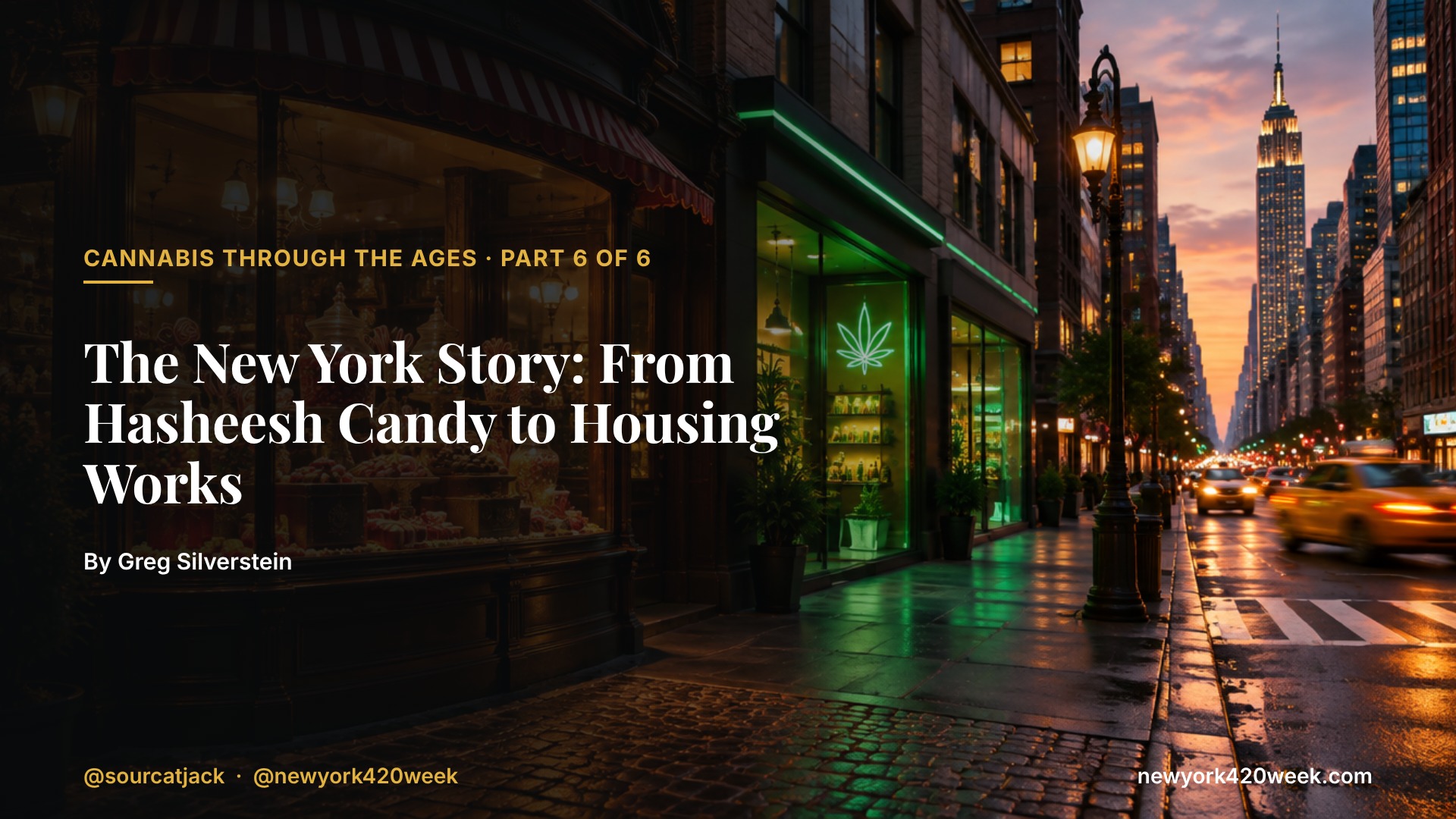
On December 29, 2022, Chris Alexander, the first head of New York's Office of Cannabis Management, walked into Housing Works Cannabis Co at 750 Broadway near Astor Place and made the state's first legal adult-use purchase. Less than a mile down the same avenue, a company called Gunjah Wallah once sold hashish candy as a cure for melancholy. Uptown, in 1939, six police officers worked undercover as social investigators to count the city's tea pads. In between those moments, New York arrested hundreds of thousands of people for the same plant. This is the whole story, told through one state and one city.
A hashish eater on Broadway
New York's cannabis story starts in a pharmacy. In the 1850s, Tilden & Co. made cannabis extract at its laboratory in New Lebanon, New York, with a city office at 98 John Street. Its 1858 catalog offered "Cannabis Indica" as a fluid extract, a solid extract and pills, for hysteria, gout, neuralgia, rheumatism and tetanus. The catalog bragged that, unlike opium, it didn't constipate you.
One of Tilden's customers became the first great American cannabis writer. Fitz Hugh Ludlow was born in New York City on September 11, 1836. In the spring of 1854, as a college student, he read Bayard Taylor's hashish account "The Vision of Hasheesh" in Putnam's Monthly and went looking for the drug himself. He found Tilden's extract on a shelf at a friend's apothecary lab. He reportedly took up to a drachm at a time, about 3.9 grams of extract, which one later researcher estimated equaled six or seven joints per dose.
In 1857, when Ludlow was 21, Harper & Bros. in New York published The Hasheesh Eater anonymously, and it sold well. He went on to write for Vanity Fair, Harper's, the Evening Post and the Atlantic, and drank with the bohemian crowd at Pfaff's beer cellar on Broadway, where Walt Whitman held court.
The city had a candy, too. In 1862, the Gunjah Wallah Co. at 476 Broadway ran ads in Vanity Fair for "Hasheesh Candy" as a remedy for nervousness and melancholy. By 1863 it had moved to 36 Beekman Street and was buying full-column ads in The Baltimore Sun. By 1866 it was a target of the anti-quackery movement.
In 1883, a writer named Harry Hubble Kane published "A Hashish-House in New York," describing a single den with a secret entrance and patrons he called men and women "of the better classes." That's where the legend of hundreds of 19th-century hashish parlors comes from, but historian Isaac Campos went looking for the evidence behind Jack Herer's famous "500 parlors" claim and found none. As far as anyone can prove, Kane's den was one exotic room, not a scene.
The city bans it first
New York City banned cannabis before New York State did. In 1914, the state passed the Boylan Act, an anti-opiate law that limited opium and morphine to prescriptions. It left cannabis out. So the city's Board of Health added cannabis indica to the Sanitary Code's list of prohibited drugs on its own, making it a misdemeanor punishable by a small fine or up to six months in jail. The New York Times reported the change on July 29, 1914, and the next day its editors called restricting the drug "only common sense."
The state caught up on April 5, 1927, when Chapter 672 classed cannabis as a "habit-forming drug" and made selling it without authorization a misdemeanor. Law professors Richard Bonnie and Charles Whitebread, writing in 1970, found no contemporary commentary explaining why marijuana was included. Their best guess was that officials feared people addicted to opiates would switch to cannabis once opium and alcohol were harder to get.
Harlem's tea pads
The man supplying a lot of it was jazz musician Mezz Mezzrow, who moved to Harlem after Prohibition and became known as the "Muggles King." Armstrong was one of his best customers, and a 1932 letter Armstrong wrote from England tells Mezzrow how to mail him marijuana. In 1940, Mezzrow was arrested carrying dozens of joints into a jazz club at the World's Fair in Flushing Meadows. He did time on Rikers Island, and later claimed he saw inmates being taken to Kings County Hospital to smoke marijuana for doctors' experiments. He published his memoir, Really the Blues, in 1946.
The places people smoked were called tea pads. In 1938, Meyer Berger of The New Yorker visited one called Chappy's Pad on 140th Street: a four-room tenement flat with nine couches, a jukebox and a faint blue light. You could buy a joint at the door and leave, or pay more to stay for the atmosphere.
The mayor who asked the question
Fiorello La Guardia wanted to know if any of the scare stories were true. On September 13, 1938, the New York Academy of Medicine learned of the mayor's concern, and in January 1939 he formally appointed the Mayor's Committee on Marihuana. It was chaired by George B. Wallace. Psychiatrist Karl Bowman ran the medical and psychiatric study, David Wechsler ran the psychological testing, and three foundations put up $7,500 each.
The street study was the remarkable part. Six New York police officers, four men and two women, worked as investigators and social workers rather than as cops. They estimated about 500 tea pads and 500 peddlers in the city, clustered in Harlem and along Broadway between 42nd and 59th Streets. They found three grades of supply: hashish imported from Africa, a Mexican and Caribbean grade, and a locally grown grade called "sass-frass." The clinical side tested 72 volunteers, all inmates of the city's Correction system.
The report came out in 1944. It found the scary publicity about marijuana in New York unfounded. It found no evidence that marijuana led to heroin, morphine or cocaine addiction, and no link to juvenile delinquency. La Guardia's foreword said clearly that this wasn't an endorsement.
Anslinger, who had written to La Guardia as early as November 1938, called the report unscientific and commissioned an American Medical Association counter-study. In April 1945, La Guardia publicly criticized a JAMA editorial attacking his committee. A New York mayor had picked a fight with the federal drug czar over the evidence, and the federal czar won the policy fight for the next 50 years.
In 1951, according to later accounts, a Sanitation Department crew called the White Wing Squad, led by inspector John E. Gleason, went borough to borough pulling up cannabis growing wild in vacant lots and burned it in Woodside, Queens.
Smoke-ins and High Times
The 1960s brought cannabis out of the jazz clubs and into the open. In the often-told story, Bob Dylan first turned the Beatles on at the Delmonico Hotel on August 28, 1964. Allen Ginsberg founded the New York chapter of LeMar, short for Legalize Marijuana, and picketed for the release of jailed smokers. In 1966 he published "The Great Marijuana Hoax" in the Atlantic, calling the dope-fiend image "palpable poppycock."
In the summer of 1967, Dana Beal handed out joints at a Grateful Dead show in Tompkins Square Park, which organizers count as New York's first unofficial smoke-in. On May 5, 1973, the Yippies held the first official one, "Jay Day," in Washington Square Park, and marched to the home of John Mitchell, Nixon's attorney general. About 5,000 people came in 1974, about 20,000 by the late 1970s, and about 30,000 by the mid-1990s. In 1996 police made more than 300 arrests. The event moved to Battery Park and shrank, down to a couple hundred people by the late 2000s, before coming back as today's NYC Cannabis Parade on the first Saturday of May.
The most famous cannabis magazine in the world was born here too. Tom Forçade founded High Times in New York in 1974 as a one-off parody of Playboy, with weed in place of sex. The first 10,000 copies sold out. By 1987 its audited circulation was 500,000. In May 1991, High Times news editor Steve Bloom printed a flyer he'd been handed at a Grateful Dead show urging people to gather on April 20 at 4:20. That's how a code word from five California teenagers became a global holiday, by way of a New York magazine. High Times left New York for Los Angeles in January 2017.
Fifteen years to life
On May 8, 1973, Governor Nelson Rockefeller signed some of the harshest drug laws in the country. Selling two ounces or possessing four ounces of heroin, cocaine or cannabis carried a mandatory minimum of 15 years to life.
The effect on the prisons was enormous. The state held about 10,000 prisoners in 1973 and about 70,000 by 2002, 19,164 of them for drug offenses. As of 2000, more than 90% of people imprisoned under the Rockefeller laws were Black or Hispanic. Governor George Pataki signed the first major reform on December 14, 2004. In January 2009, Governor David Paterson said, "I can't think of a criminal justice strategy that has been more unsuccessful," and that April the state ended the mandatory minimums.
The 1977 deal, and the trick that broke it
In 1977, under Governor Hugh Carey, New York repealed the marijuana sections of the Rockefeller laws and decriminalized possession of 25 grams or less, making a first offense a $100 violation. According to research by Harry Levine, the push came largely from parents of white, middle-class college kids upstate who had been arrested.
There was a catch. Burning marijuana or displaying it "in public view" stayed a misdemeanor. Levine documented how police used that line. Officers would stop someone, tell them to empty their pockets, and once the bag was out in the open, it was public view and an arrestable crime. Levine said police "invented this trick."
The arrest capital
For the next four decades, that loophole drove one of the largest marijuana enforcement campaigns in the world. Under Mayor Ed Koch, drug arrests of all kinds rose from about 18,000 in 1978 to 94,000 in 1989. Marijuana arrests took off in the mid-1990s: about 5,700 in 1995, more than 51,000 in 2000. In April 2008, the New York Civil Liberties Union reported that police had arrested nearly 400,000 people for small amounts in the previous decade, making the city the world leader in marijuana arrests. In 2011, the NYPD made about 50,700 low-level marijuana arrests, and 86% of the people arrested were Black or Latino.
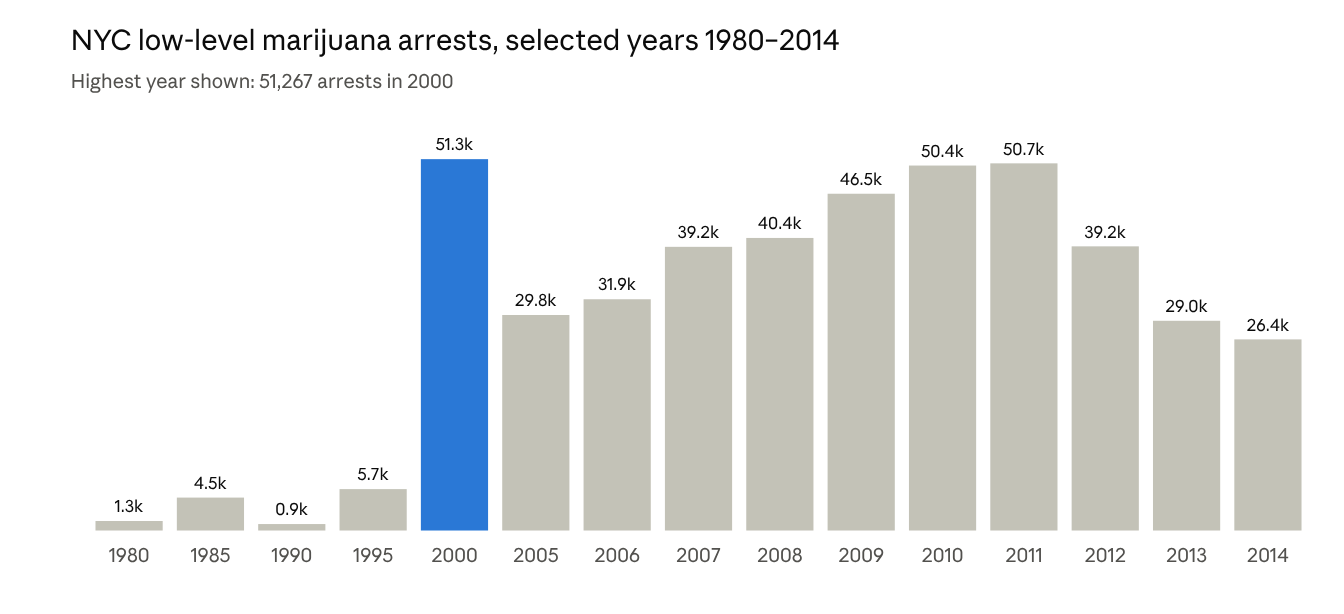
Arrests jumped roughly ninefold between 1995 and 2000 and stayed between about 30,000 and 51,000 a year from 2005 through 2012.
Many of those arrests started with a stop-and-frisk. On August 12, 2013, in Floyd v. City of New York, federal judge Shira Scheindlin ruled the NYPD's stop-and-frisk practices unconstitutional. The case covered 4.4 million stops since 2004. Of the people stopped, 83% were Black or Latino, and 98% had no weapon. "No one should live in fear of being stopped whenever he leaves his home," she wrote.
In November 2014, Mayor Bill de Blasio and Police Commissioner Bill Bratton announced that officers would write tickets instead of making arrests for small possession. Arrests fell, but the pattern didn't: in 2017, 86% of people arrested for marijuana in the city were still Black or Hispanic. In May 2018, Manhattan District Attorney Cyrus Vance announced he would stop prosecuting possession and public smoking, a move projected to cut those cases by 96%. Brooklyn's Eric Gonzalez said he would decline some public-smoking cases, and the Bronx's Darcel Clark urged summonses instead of arrests.
The slow road to medical
Governor Andrew Cuomo signed the Compassionate Care Act in July 2014, but New York's medical program was built to be cautious. Five companies got licenses, each allowed four dispensaries. The law said medical marijuana may not be smoked. The first eight dispensaries opened on January 7, 2016. By September 2016, New York had about 7,000 registered patients. Michigan had about 182,000. Ground flower was finally allowed in 2017, but only as metered preparations, and the program later grew to ten companies.
On July 13, 2018, the state Department of Health delivered a report to Cuomo concluding that a regulated adult-use market would benefit public health. It noted that New York's marijuana arrest rate in 2010 had been twice the national average. A legalization bill sponsored by State Senator Liz Krueger and Assembly Majority Leader Crystal Peoples-Stokes stalled in 2019. Lawmakers passed decriminalization instead. From August 28, 2019, possession under two ounces became a violation, with a $50 fine under an ounce and $200 for one to two ounces, and past records were set to be cleared.
Legal at last
On March 31, 2021, Cuomo signed the Marihuana Regulation and Taxation Act. Adults 21 and older can carry three ounces of flower and 24 grams of concentrate, and can smoke wherever tobacco smoking is allowed. The law set a 9% state tax plus local and THC-based taxes, aimed to give half of all licenses to social and economic equity applicants, directed 40% of revenue to communities hit hardest by enforcement, and made expungement automatic. It created the Office of Cannabis Management and a five-member Cannabis Control Board. Employers generally can't test applicants or fire workers for off-hours use.
New York did something no state had done with its first stores. The Conditional Adult-Use Retail Dispensary program, CAURD, reserved the first retail licenses for people who had been convicted of cannabis offenses, plus a handful of nonprofits. The first growers were existing hemp farmers. In April 2022, Governor Kathy Hochul handed out the first conditional cultivator licenses. Kate Miller of Weathertop Farm in Otsego County, who'd grown hemp on about two and a half acres, was among the first 52.
On November 21, 2022, the Cannabis Control Board approved the first 36 CAURD licenses while more than 900 applicants waited. Twenty-eight went to businesses and eight to nonprofits. One winner, Nicholas Koury, had started dealing at 13 in East Harlem and had been caught with four pounds in his trunk in 2017. He was running a gym in Mount Vernon when he got the license.
Housing Works opened on December 29, 2022. On January 24, 2023, Smacked Village opened at 144 Bleecker Street as the city's second legal store, billing itself as the first owned by an individual. Its owner, Roland Conner, had been locked up as a teenager in the 1990s on a marijuana charge. Union Square Travel Agency opened with a partnership that sends 51% of its proceeds to the Doe Fund, a nonprofit for formerly incarcerated people.
The rocky rollout
The ambition outran the machinery. The state promised a $200 million public-private fund to find, build out and lease stores for CAURD licensees. By November 2023, THE CITY reported, the fund held 24 leases and only eight fund-supported stores had opened. Licensees like Berkay Sebat, who quit an engineering job and spent about $100,000 waiting on a SoHo location, were left in limbo.
Farmers got squeezed from the other side. More than 200 growers harvested about 300,000 pounds in 2022, when only about a dozen stores were open. By June 2023, Seth Jacobs of Slack Hollow Organics in Argyle was sitting on about 700 pounds of flower in roughly 100 bins.
Then came the lawsuits. In September 2022, a Michigan-based company called Variscite sued over the CAURD rules, and Judge Gary Sharpe froze licensing in five regions. The freeze was narrowed in March 2023 and ended with a settlement on May 30, 2023. In August 2023, a state judge froze CAURD again after service-disabled veterans sued, and that injunction didn't lift until December 1, 2023.
Meanwhile, unlicensed smoke shops filled every block. In April 2024, the state had about 100 licensed stores and 14 OCM investigators. That May, the state budget gave local governments padlocking power, and the city launched Operation Padlock to Protect with the Sheriff's Office and the NYPD. By July 31, 2024, city and state task forces had closed more than 1,000 illegal shops. By mid-June, Hochul said legal stores near closed shops had seen sales rise 27%. The closures kept coming: on February 18, 2026, inspectors padlocked a shop at 645 Rogers Avenue in Prospect Lefferts Gardens, next to a day care, and seized about $1.4 million worth of product.
The leadership churned. Alexander left OCM in 2024 after a critical state review found an understaffed licensing team. Tremaine Wright stepped down as chair of the Cannabis Control Board in June 2025, and Jessica Garcia took over. In July 2025, OCM told 152 businesses their locations might violate the 500-foot school rule because of a dispute over how to measure; the fix Hochul signed on February 11, 2026 let existing licensees stay where they were. In October 2025, OCM moved to revoke Omnium Health's licenses over an alleged rent-a-license scheme, then withdrew those charges in December. On December 8, 2025, acting director Felicia Reid was out, and deputy counsel James Rogers was set to leave that week. In February 2026, Hochul named John Kagia, OCM's policy director, to lead the office, and the state Senate confirmed him as executive director in early June 2026.
Where New York stands in 2026
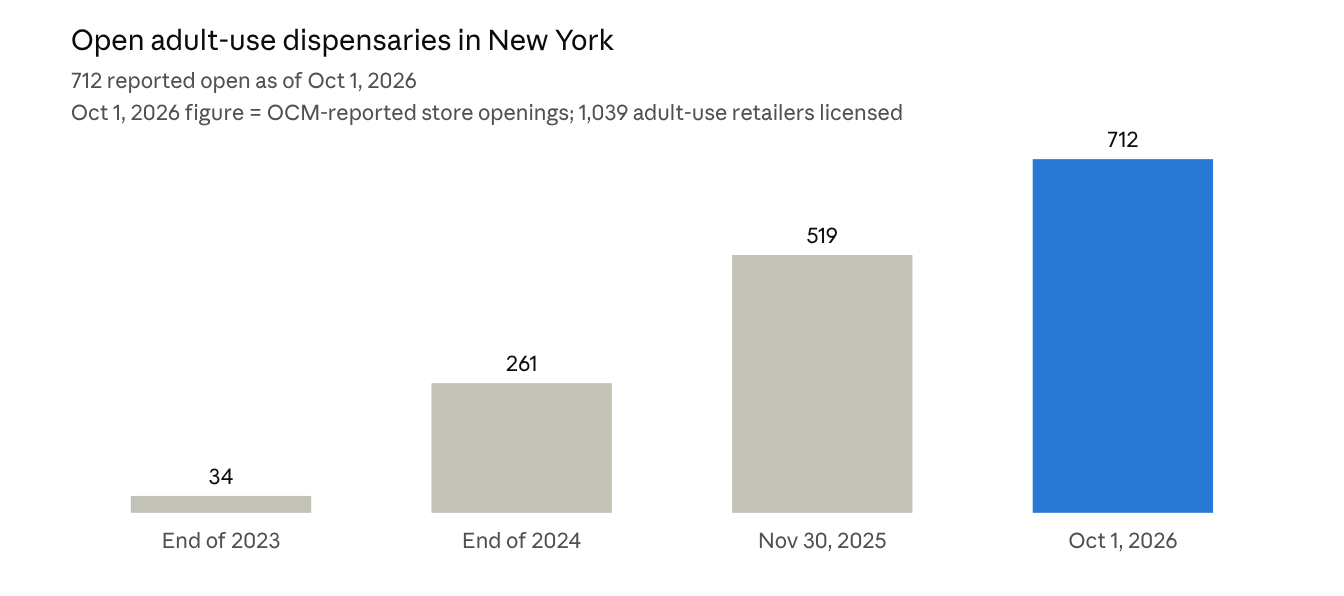
For all the chaos, the market grew fast. New York had 34 dispensaries open at the end of 2023, 261 at the end of 2024 and 519 by November 30, 2025. By the fall of 2026 the state had licensed 1,039 adult-use retailers, 712 were open, and 735 adult-use dispensaries recorded sales in September, according to OCM's October 1 presentation to the Cannabis Control Board. Counting every kind, OCM had issued 2,351 adult-use licenses, including 370 CAURD licenses, by the October 1 meeting. As of August, fifty-six percent of all licenses have gone to social and economic equity applicants.
Sales followed. Sales went from $155.3 million in 2023 to $889.8 million in 2024 and about $1.69 billion in 2025, according to OCM. Cumulative adult-use sales passed $3 billion in early March 2026 and reached $4.1 billion by the end of September. In the first nine months of 2026 the state sold $1.41 billion, including a record third quarter of $512.6 million. During 4/20 week in 2026, New Yorkers spent about $37.9 million, up 20% from the year before, and the best single day hit $8.6 million. Prices are falling: OCM's average price per unit fell about 8% in 2026. In March, OCM forecast $2.6 billion for 2026; by July it had cut that to between $2 billion and $2.5 billion, and the current pace points to about $2 billion.
The supply side is still finding its footing. In March 2026, OCM counted 560 licensed cultivators with about 9.1 million square feet of approved canopy, but only about three in four were operating, using about half their permitted space.
The rules keep expanding. Adults have been allowed to grow at home since June 26, 2024: three mature and three immature plants each, up to six of each per household, and you can gift up to three ounces. In November 2025, Hochul signed a law letting medical patients 18 and older grow at home, extending certifications to two years and recognizing out-of-state patients. In May 2026, OCM opened applications for Cannabis Showcase Events, letting dispensaries team up with growers and processors to sell at pop-ups and farmers' markets. The city's loan fund for licensees widened to more than 540 businesses with loans up to $500,000. Consumption lounges, though, are still waiting. Applicants who paid rent on lounge space for nearly two years had no licenses as of mid-2025, and OCM's 2026 board releases don't mention lounges at all.
What New York tells us
New York has played every role in cannabis history. It was a pharmacy town that sold cannabis extract for gout and hashish candy for the blues. It banned the plant city by city before the federal government did. It ran the most serious local study of marijuana in American history, then spent four decades ignoring it, and became the arrest capital of the world. And then it built a legal market that tried, imperfectly, to hand the first keys to the people the old laws had hurt most.
The new market is messy, underbuilt and still arguing with itself. But walk down Broadway today and you'll pass legal dispensaries a few blocks from where Gunjah Wallah sold its candy, and that's a long way to have come.
Sources
- NY Governor's office: first adult-use cannabis retail sales (Dec 2022)
- Points: Gunjah Wallah and hasheesh candy
- Schaffer Library: LaGuardia Committee introduction (1944)
- Schaffer Library: Tilden & Co. extract catalog (1858)
- Wikipedia: Fitz Hugh Ludlow
- Public Domain Review: The Hasheesh Eater (1857)
- Isaac Campos: A Hashish-House in New York and the 500-parlor claim
- Bonnie & Whitebread: The Forbidden Fruit, early New York law (1970)
- Wikipedia: Mezz Mezzrow
- Wikipedia: If You're a Viper
- Very Important Potheads: Mezz Mezzrow
- Points: Finding the Tea Pad
- Points: The Eyes of the City, La Guardia's Committee on the Marihuana Problem
- NYAM Center for History: the LaGuardia Report
- Brooks, Journal of Policy History: Marijuana in La Guardia's New York City, 1938-1945
- Wikipedia: LaGuardia Committee report
- Wikipedia: Cannabis in New York
- Project CBD: When Bob Dylan turned on the Beatles
- Boulder Weekly: Allen Ginsberg on pot
- NYC Cannabis Parade: history of the smoke-ins
- Wikipedia: High Times
- Cannigma: the real 420 origin story
- Wikipedia: Rockefeller Drug Laws
- Points: the failure to legalize adult-use cannabis in New York (1977 law)
- City Limits: four decades of drug war in New York City (2009)
- Fox News/AP: NYC marijuana arrests by year
- New York Sun/AP: NYCLU report on marijuana arrests (2008)
- ACLU: NYC marijuana arrests still too high
- Civil Rights Clearinghouse: Floyd v. City of New York (2013)
- Amsterdam News: judge deems stop-and-frisk unconstitutional (2013)
- DNAinfo: police won't arrest most people with small amounts of marijuana (Nov 2014)
- WNYC: district attorneys soften marijuana enforcement (2018)
- Marijuana Policy Project: New York's Compassionate Care Act overview
- NY OCM: Compassionate Care Act two-year report, 2014-2016
- CBS/AP: New York medical marijuana patients (2016)
- NY Department of Health: regulated marijuana report (July 13, 2018)
- JD Supra: NYS Department of Health report summary (2018)
- UPI: Cuomo signs decriminalization law (2019)
- NORML: Cuomo signs marijuana legalization (Mar 31, 2021)
- Wikipedia: Marihuana Regulation and Taxation Act
- MMJ Daily: licensed growers in New York
- THE CITY: first CAURD licenses approved (Nov 2022)
- NBC New York: second legal dispensary opens (Jan 2023)
- Time Out New York: first dispensary from a justice-impacted owner (Jan 2023)
- K. Stetz Substack: whatever happened to CAURD, part II
- THE CITY: CAURD social equity fund (Nov 2023)
- AP via ABC17: slow start leaves New York farmers holding the bag (2023)
- Harris Sliwoski: the Variscite injunction is lifted (2023)
- THE CITY: veterans' lawsuit and CAURD injunction (Aug 2023)
- CNYCentral: illicit shops outnumber legal dispensaries (Apr 2024)
- NY1: more than 1,000 illegal shops closed (Jul 2024)
- CBS New York: legal sales up near closed illegal shops (Jun 2024)
- Hoodline: Prospect Lefferts Gardens smoke shop padlocked (Feb 2026)
- Feldman Legal Advisors: OCM chief resigns after critical review (2024)
- MJBizDaily: Tremaine Wright leaves the Cannabis Control Board (Jun 2025)
- Cannabis Business Times: 152 stores hit by location guidance (2025)
- NY OCM: proximity correction (Feb 2026)
- Spectrum News: Hochul ousts OCM acting chief (Dec 2025)
- Spectrum News: Hochul names new OCM head (Feb 2026)
- Spectrum News: Senate confirms OCM executive director (Jun 2026)
- NY OCM: 2025 Annual Report
- NY OCM: Cannabis Control Board meeting deck (Oct 1, 2026)
- NY OCM: Cannabis Control Board release (Aug 6, 2026)
- NY OCM: Cannabis Control Board presentation (Feb 5, 2026)
- NY OCM: Cannabis Control Board press release (Apr 3, 2026)
- The Marijuana Herald: record $512.6M Q3 sales (Oct 2026)
- NY OCM: Cannabis Control Board release (May 2026)
- MJBizDaily: New York sales on pace to beat California (Mar 2026)
- NY OCM: Cannabis Control Board minutes (Jul 2, 2026)
- MJBizDaily: record pace, signs of stall (Oct 2026)
- Emerald Magazine: March CCB meeting (2026)
- NY OCM: home cultivation FAQs
- Marijuana Moment: Hochul signs medical marijuana expansion (Nov 2025)
- Chronogram: the great wait for lounge licenses