NJ Medical Cannabis Lost Two of Every Three Patients
Registered patients fell from 129,369 to 42,984 since adult-use began. The cause is total cost and convenience, and the promised fix is nine months late.
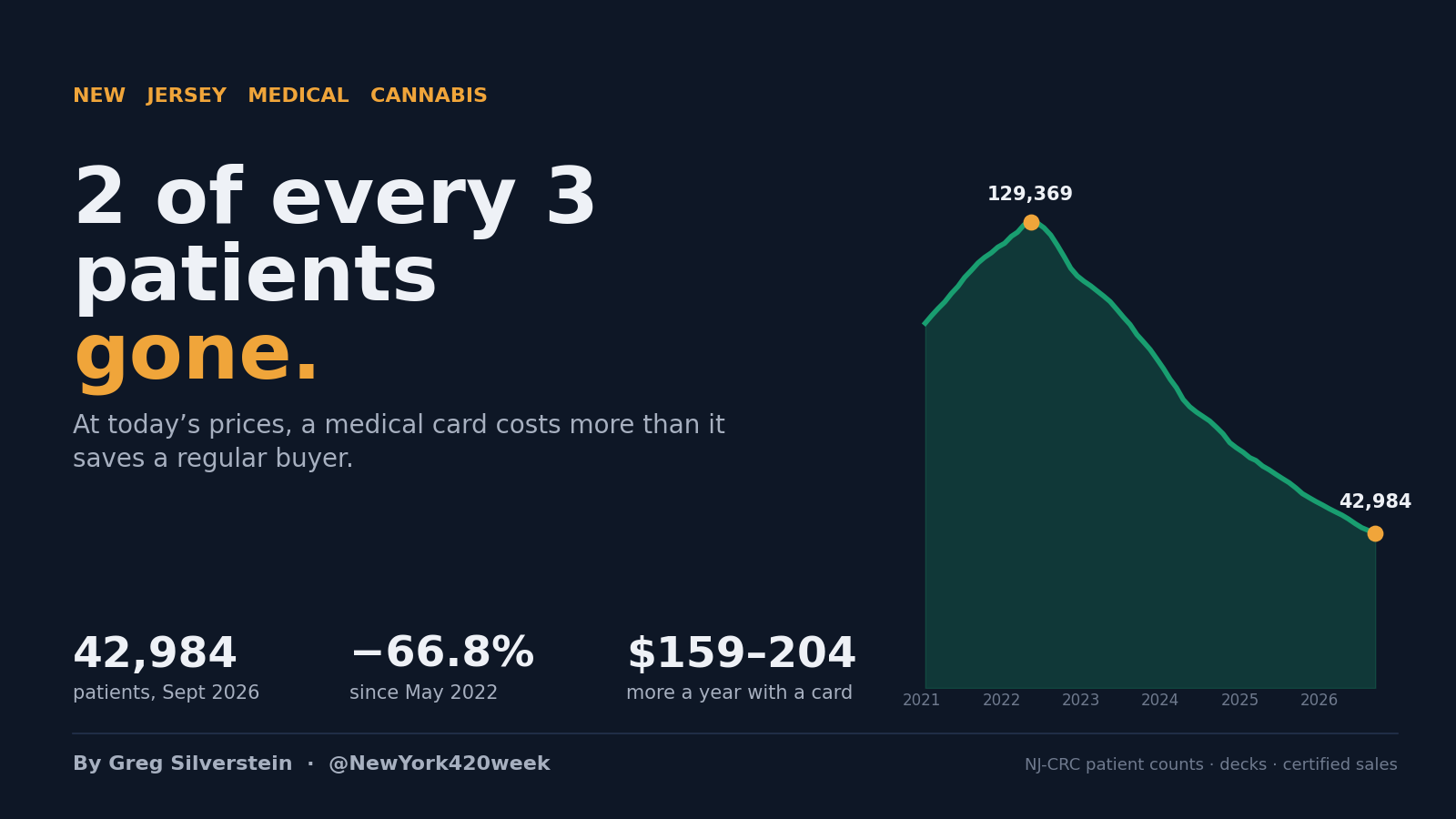
On May 15, 2022, a month after New Jersey's adult-use dispensaries opened, the state's medical cannabis program had 129,369 registered patients. That was its peak.
It has shrunk every month since. On September 15, 2026, the count was 42,984, down 86,385 patients or 66.8%. That's 52 straight monthly declines, by the New Jersey Cannabis Regulatory Commission's (CRC) own figures.
Where those 86,000 people went is the question nobody tracks. Some now shop adult-use. Others likely went back to their local plug. Either way, the medical program is a clear case of the problem facing the whole legal market in New Jersey. People choose on the full cost of getting cannabis, and on whether good, affordable product is easy to get. The medical program has been losing on both.
The numbers
| Peak | Latest | Change | |
|---|---|---|---|
| Registered patients | 129,369 (May 2022) | 42,984 (Sept 2026) | −66.8% |
| Caregivers | 5,372 (Dec 2023) | 2,803 (Sept 2026) | −47.8% |
| Medical sales, full year (certified) | $226.1M (2022) | $46.2M (2025) | −79.6% |
| Medical sales, one quarter (certified) | $61.1M (Q3 2022) | $7.6M (Q4 2025) | −87.6% |
| Medical share of legal sales, by quarter | 42.6% (Q2 2022) | 2.5% (Q4 2025) |
Medical patients bought less in all of 2025 ($46.2 million) than in the single third quarter of 2022 ($61.1 million).
The losses haven't slowed much:
- 14,902 patients left in 2025 (from 66,678 in December 2024 to 51,776 in December 2025).
- Another 8,792 left in the first nine months of 2026.
- Medical sales in Metrc fell to $2.77 million in June 2026, down 41% from a year earlier, by the CRC's count.
Cheaper on the shelf, still too expensive overall
For most of the decline, medical flower was cheaper than adult-use. In every CRC price series from 2022 into 2025, a medical gram cost less, often by $1 to $2, and patients pay no sales tax. Patients still left, more than 3,000 in a single month at the worst (April 2024).
That's the clearest evidence that shelf price isn't the whole story. The price that matters is the net cost of being a patient:
- The doctor. Joining or staying in the program requires a paid certification from a registered practitioner, at a price the state doesn't set. The CRC's 2023 patient survey listed "high doctor fees" among patients' top complaints.
- The paperwork. Patients re-register and are assigned to a single alternative treatment center (ATC). The same survey named "frustration with the registration process with a single ATC."
- The product. The survey also cited "inconsistent product availability, lack of product variety, and the maximum monthly allotment," along with "the high cost of cannabis."
The state has cut its own charges: the card fee went from $100 to $50 in July 2022 (Resolution 2022-35), and the 2023 annual report says renewals fell to $10 for two years. Those were never the biggest costs.
The shelf-price advantage has now flipped as well. In the CRC's latest price series (July 16, 2026 deck):
| Month | Adult-use, per gram | Adult-use after 6.625% tax | Medical, per gram (no sales tax) |
|---|---|---|---|
| June 2025 | $8.33 | $8.88 | $8.05 |
| October 2025 | $7.98 | $8.51 | $7.77 |
| February 2026 | $7.17 | $7.65 | $7.50 |
| June 2026 | $6.51 | $6.94 | $7.02 |
Adult-use has been cheaper on the shelf every month since February 2026. After tax, a June 2026 adult-use gram ($6.94) cost about the same as a medical gram ($7.02). Add the doctor's fee, and on the average gram the card no longer pays for itself.
(The December 2025 deck showed medical flower at $6.89 in October 2025. The CRC later revised that month to $7.82 and then to $7.77. The $6.89 figure is out of date.)
The math: a year of cannabis, with and without a card
Take a regular consumer buying 1.5 ounces of flower a month. That's 18 ounces a year (504 grams), a little over a pound. Here's what it costs at the CRC's June 2026 average prices, with and without a medical card.
| June 2026 prices | Without a card (adult-use) | With a card (medical) |
|---|---|---|
| 504 grams of flower | $3,281 ($6.51/g) | $3,538 ($7.02/g) |
| State sales tax (6.625% adult-use, 0% medical) | $217 | $0 |
| Doctor's certification, once a year | — | $119–$159 |
| State patient ID ($0 digital; $10 physical, good for two years) | — | $0–$5 |
| Total for the year | $3,498 | $3,657–$3,702 |
At today's average prices, the card costs about $159 to $204 more a year than just buying adult-use. For exactly one pound a year, the gap is about $155 to $200.
That money doesn't need to go to a doctor. The $119 to $159 certification visit alone would buy about 17 to 23 grams of adult-use flower after tax, somewhere between half an ounce and 0.8 of an ounce. Spent on cannabis instead of an appointment, it goes straight to the product.
It wasn't always this way. The same 18 ounces a year, using the card costs above:
| Prices from | Adult-use total, after tax | Medical total, with card | The card… |
|---|---|---|---|
| January 2024 ($12.49 adult-use / $10.92 medical per gram) | $6,712 | $5,623–$5,668 | saved $1,044–$1,089 |
| June 2025 ($8.33 / $8.05) | $4,476 | $4,176–$4,221 | saved $255–$300 |
| June 2026 ($6.51 / $7.02) | $3,498 | $3,657–$3,702 | cost $159–$204 more |
In two and a half years, the card went from saving a heavy consumer about $1,000 a year to costing money. The state's own fee actually fell, to $10 or nothing. What changed is that adult-use prices dropped below medical prices, so the doctor's fee is now bigger than anything the card saves on tax.
A few caveats:
- These are the CRC's statewide averages across all flower, not what any one store charges for an ounce. Bulk sizes, medical discounts and loyalty deals can change the math for a particular buyer.
- Towns can add up to 2% in local cannabis tax. It can apply to both medical and adult-use, so it's left out of both columns.
- The card still gives some patients things money can't easily replace: a 3-ounce monthly limit, legal documentation, express lines and medical-only products.
For the average buyer, though, the choice is simple arithmetic. It helps explain why the program keeps shrinking, and why net price, what someone actually pays all-in, is what moves customers.
Access got harder, not easier
Patient-only hours ended. In December 2024 (Resolution 2024-311), at the request of the New Jersey Cannabis Trade Association, the CRC eliminated the requirement that expanded ATCs, meaning medical operators that also sell adult-use, keep patient-only hours. The change applied to every existing approval. Stores still have to offer express patient access and dedicated patient registers.
Medical operators kept moving into adult-use. The CRC counted 80 expanded ATCs in February 2025 and 91 in July 2026. The same stores now serve both markets, and adult-use is 97.5% of the dollars.
The rules stayed the same. In February 2026 the CRC readopted the medical rules. Its deck: "Readopting with no amendments."
The promised fix hasn't appeared.
- In February 2025, then-Chair Dianna Houenou created a Medical Patient Access Committee (Houenou and Commissioner Amelia Mapp) to "make recommendations for reducing patients' costs for medicinal cannabis and ensuring equitable access to care."
- The CRC's website still says: "By December 1, 2025, the committee shall submit a report to the Board on the Committee's findings, including any recommended Agency actions."
- We found no such report in any board deck from March 2025 through September 2026, or among the CRC's published resolutions and reports.
- Houenou has since left the Commission. Harris Laufer was elected Chair in April 2026.
In its 2023 annual report, the CRC called that year's 21% drop in active patients "typical of state programs upon the opening of an adult-use cannabis market." The loss since the peak is now more than three times that.
The numbers that don't match
The CRC reports medical sales two ways: monthly Metrc figures at its meetings, and Treasury-certified quarterly totals. They don't line up:
| Quarter | Metrc (sum of monthly deck figures) | Certified | Gap |
|---|---|---|---|
| Q1 2025 | $16.41M | $12.97M | −21.0% |
| Q2 2025 | $15.20M | $15.75M | +3.7% |
| Q3 2025 | $12.83M | $9.90M | −22.8% |
| Q4 2025 | $11.55M | $7.59M | −34.3% |
The CRC's footnotes say Metrc excludes non-cannabis items and that "all sales data may change retroactively." Neither explains a one-third gap. Possible reasons include medical sales under-reported to Treasury, tax-exempt sales filed differently, or some sales at combined stores tagged as medical in Metrc.
Who is left, and what would bring people back
The remaining 43,000 patients include the people with the fewest alternatives:
- homebound and terminally ill patients who depend on caregivers;
- patients who need more than adult-use limits allow;
- patients who need products only the medical side sells.
Minors can't buy adult-use at all. Small medical-only operators are exposed too: the CRC charges a $20,000 annual ATC permit renewal fee, and in December 2025 it denied waivers to two small medical-only dispensaries, Design 710 and Restore NJ (Resolutions 2025-12-17-16 and -17).
The lesson reaches beyond the medical program. New Jersey's legal market, medical and adult-use alike, grows when it beats the alternative on the total cost to the customer and on affordable, accessible quality. The medical program lost two-thirds of its patients on those terms. The adult-use market faces the same test with every shopper who still buys from a local plug.
Method and sources
- Patients: CRC "Month to Month Patient Numbers" (as of the 15th of each month), January 2021–September 2026. Caregivers and doctors: CRC board decks (September 9, 2026: 43,043 patients, 2,803 caregivers as of September 3, 2026). Caregiver peak (5,372) from the December 6, 2023 deck.
- Sales: CRC "Cannabis Sales Totals" (Treasury-certified), 2022–2025; monthly medical sales from CRC decks (Metrc). The 97.5% adult-use share is Q4 2025 certified.
- Prices: CRC decks, bud/flower price per gram, latest version from the July 16, 2026 deck. After-tax column is our arithmetic (× 1.06625, state sales tax only).
- Survey and "typical" quote: CRC 2023 Annual Report.
- Card cost analysis: our arithmetic. 1.5 oz/month = 18 oz = 504 g a year (28 g per ounce); one pound = 453.6 g. Prices: CRC average adult-use and medical bud/flower price per gram (February 18, 2025 deck for January 2024; July 16, 2026 deck for June 2025 and June 2026). Adult-use includes 6.625% state sales tax; medical is exempt (CRC patient FAQ). Municipal tax (up to 2%) excluded from both.
- Card costs: State ID $10 for two years, free with a digital ID (CRC announcement, December 7, 2023; CRC patient FAQ). Doctor's certification: telehealth list prices in September 2026 of $159 (new patient) and $119 (renewal) at Miracle Leaf, and $149.99 (renewal) at MMJ.com. The CRC lets the practitioner decide how often to re-authorize ("You decide how often the patient requires a new authorization"). Providers describe renewal as annual in practice, which is what we assume. In-person visits may cost more.
- Committee: CRC February 18, 2025 deck (Chair's report); CRC "Commission Leadership" page.
- Actions: CRC Resolutions 2022-35, 2024-311, 2025-12-17-16, 2025-12-17-17; February 12, 2026 deck (rule readoption); expanded-ATC counts from the February 18, 2025 and July 16, 2026 decks.
- Analysis: Where departing patients went is not tracked by the CRC. The view that total cost and affordable, accessible quality drive customers' choices, including the choice to buy from unlicensed sellers, is New York 420 Week's analysis of the figures above.