Research /Research
The Twenty-Three Companies That Are Florida Weed
779 stores, 434 million milligrams a week, and one uncomfortable fact: the busiest dispensaries in the state belong to the smallest chains.
Watch the story

Twenty-three companies dispense medical cannabis in Florida. Between them they run 779 stores and moved 434 million milligrams of THC in the week of September 5-11, 2026. That is the entire legal supply of intoxicating cannabis for a state of 23 million people.
It is also more concentrated than the storefront count suggests. Those 23 retail brands roll up into 21 ownership groups, and four of them control 58% of the volume. But the concentration story and the performance story point in opposite directions, and the gap between them is the most interesting thing in Florida cannabis right now.
Trulieve is still the market
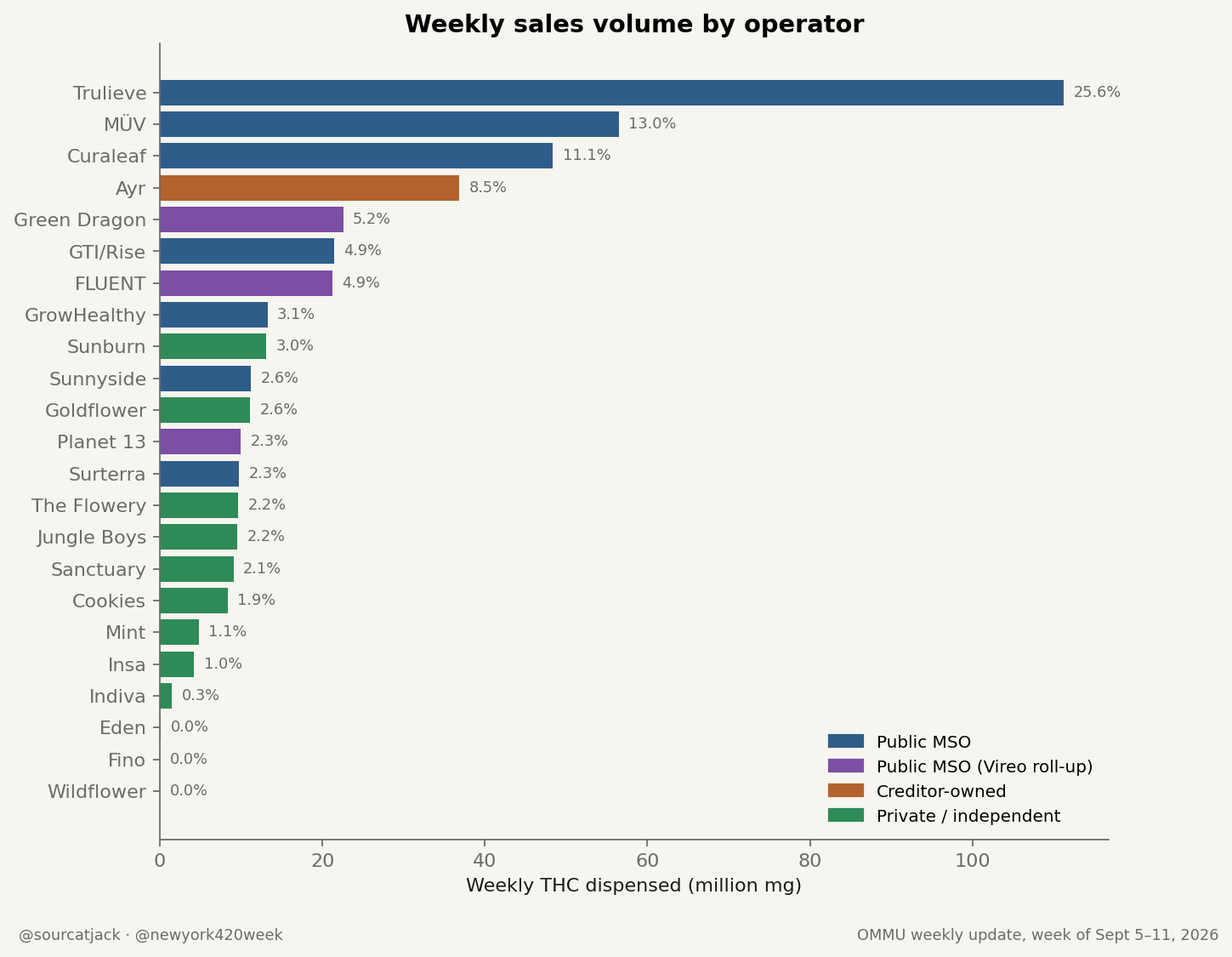
Trulieve dispensed 111 million milligrams in the week of September 11 - 25.6% of everything sold in Florida, from 170 stores. That is more than the next two operators combined. MUV, Verano's Florida brand, has overtaken Curaleaf for second at 13.0% from 86 stores; Curaleaf is at 11.1% from 77.
Behind that sits a physical advantage nobody else has: a 750,000 sq ft automated indoor grow on a campus of more than a million square feet in Jefferson County. In a state where every licence must grow, process and sell its own product, with no wholesale market to buy from, cultivation capacity is not a detail. It is the business.
The twist: the busiest doors are the smallest chains
Divide each operator's weekly volume by its store count and the ranking inverts.
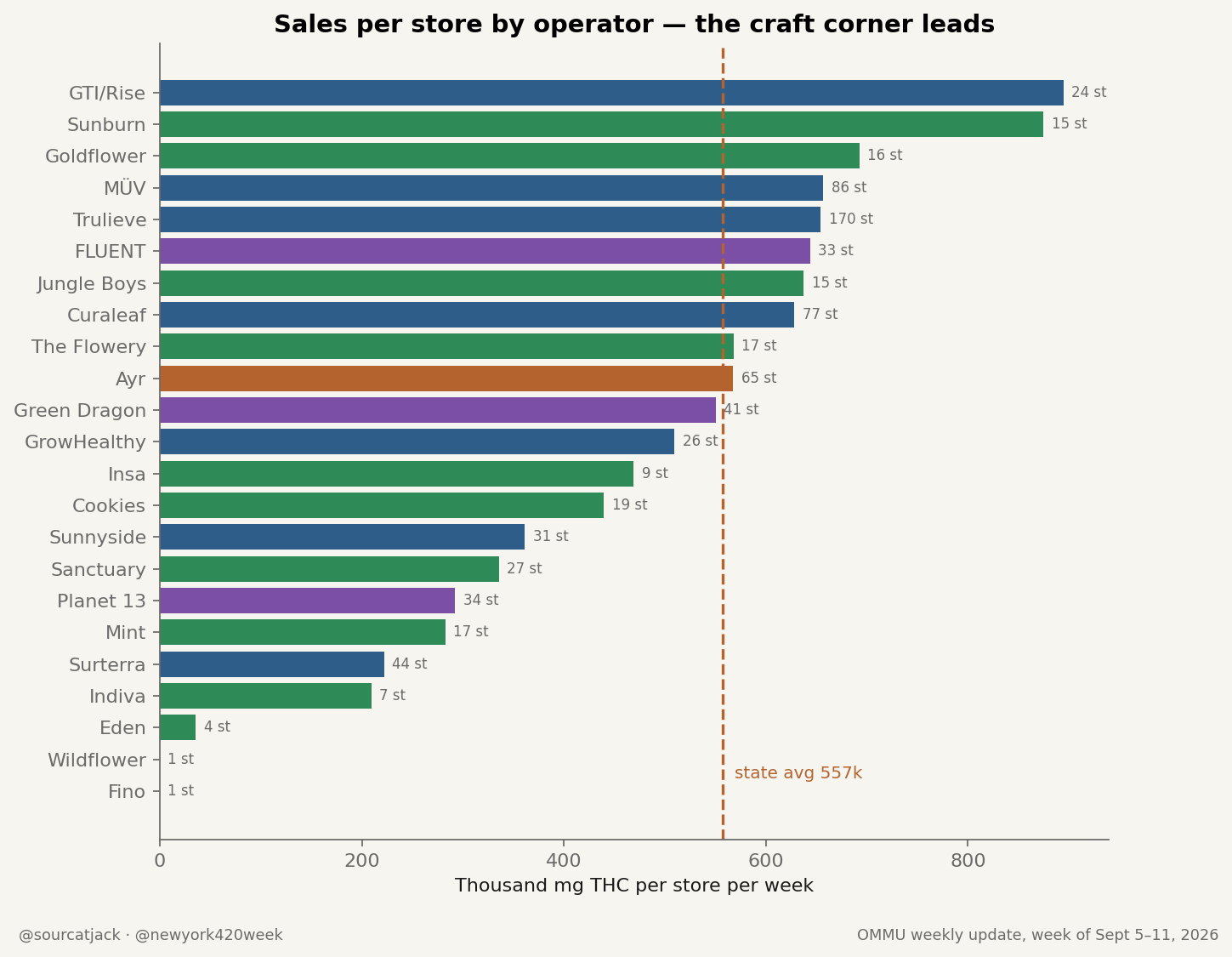
Green Thumb's Rise stores move about 895,000 milligrams per store per week from 24 locations. Sunburn — running the licence MedMen sold in 2022 — moves about 875,000 from fifteen. Goldflower does about 693,000 from sixteen. The state average is 557,000. Trulieve, at 170 stores, sits at 654,000: respectable at that scale, but nowhere near the top.
The spread between the best and worst operator is roughly three to one, and it comes down to two things. The first is product and price position: craft operators with waiting-list flower sell out of a small footprint. The second is the grow. An operator cannot sell what it cannot cultivate, and several of the weakest per-store performers are precisely the ones who have closed cultivation or never built it.
At the bottom of the table are the mid-sized chains with neither scale nor a craft premium — Planet 13 at 292,000 per store and Cresco's Sunnyside at 362,000. Planet 13 has since agreed to sell itself.
What each company actually grows
Vertical integration is Florida's real barrier to entry, and the capacity table is where the market's future gets decided.
Two operators have genuine scale: Trulieve's 750,000 sq ft and Curaleaf's 362,000 sq ft at Mount Dora. Green Dragon's Palatka campus is physically bigger than Curaleaf's at 416,000 sq ft, but only about 150,000 is in use.
The distressed operators are shrinking. Surterra now supplies 44 stores from roughly 175,000 sq ft after Parallel closed 330,000 sq ft of Tampa-area greenhouse and laid off 211 people in July. FLUENT closed its Ruskin site and runs about 103,000 sq ft across four locations while carrying going-concern doubt in its own filings. Both have more retail than cultivation to feed it — a condition that usually shows up as thin menus within two or three quarters.
The craft operators are constrained in the other direction. Sunburn runs 30,000 sq ft of canopy at Eustis plus a Winter Garden facility. The Flowery runs about 100,000 sq ft at Homestead. Insa runs a single building in Auburndale housing cultivation, extraction and edibles. These are the operators posting the highest sales per store, and they are selling everything they can grow.
Then there is the group that discloses nothing at all. Goldflower had a new cultivation site approved in February 2026 and has never published its size. For a company running sixteen stores at 693,000 milligrams each, that is arguably the most consequential undisclosed number in Florida.
Three brand strategies
Deep third-party rosters. Trulieve carries around fifteen partner labels — Alien Labs, Connected, Khalifa Kush, Seed Junky, Blue River — alongside eight house brands. The Flowery has built its entire identity on partner flower: 710 Labs, Runtz, Backpack Boyz, Sherbinskis, Wizard Trees, plus Airo vapes. Both sit at or above the state average per store.
House-only. Jungle Boys, Insa, Sunburn, Fino, Eden and Wildflower sell only what they make. For the strong brands that is a margin advantage; for the weak ones it caps the shelf.
A single licensed anchor. Ayr licenses Kiva's Camino, Petra and Lost Farm lines plus Dompen. Goldflower grows Michigan's Heavyweight Heads under licence. MÜV has an exclusive with Edie Parker. It is the cheapest way to put a recognised name on the shelf without ceding control of it.
One company is buying the number-two position
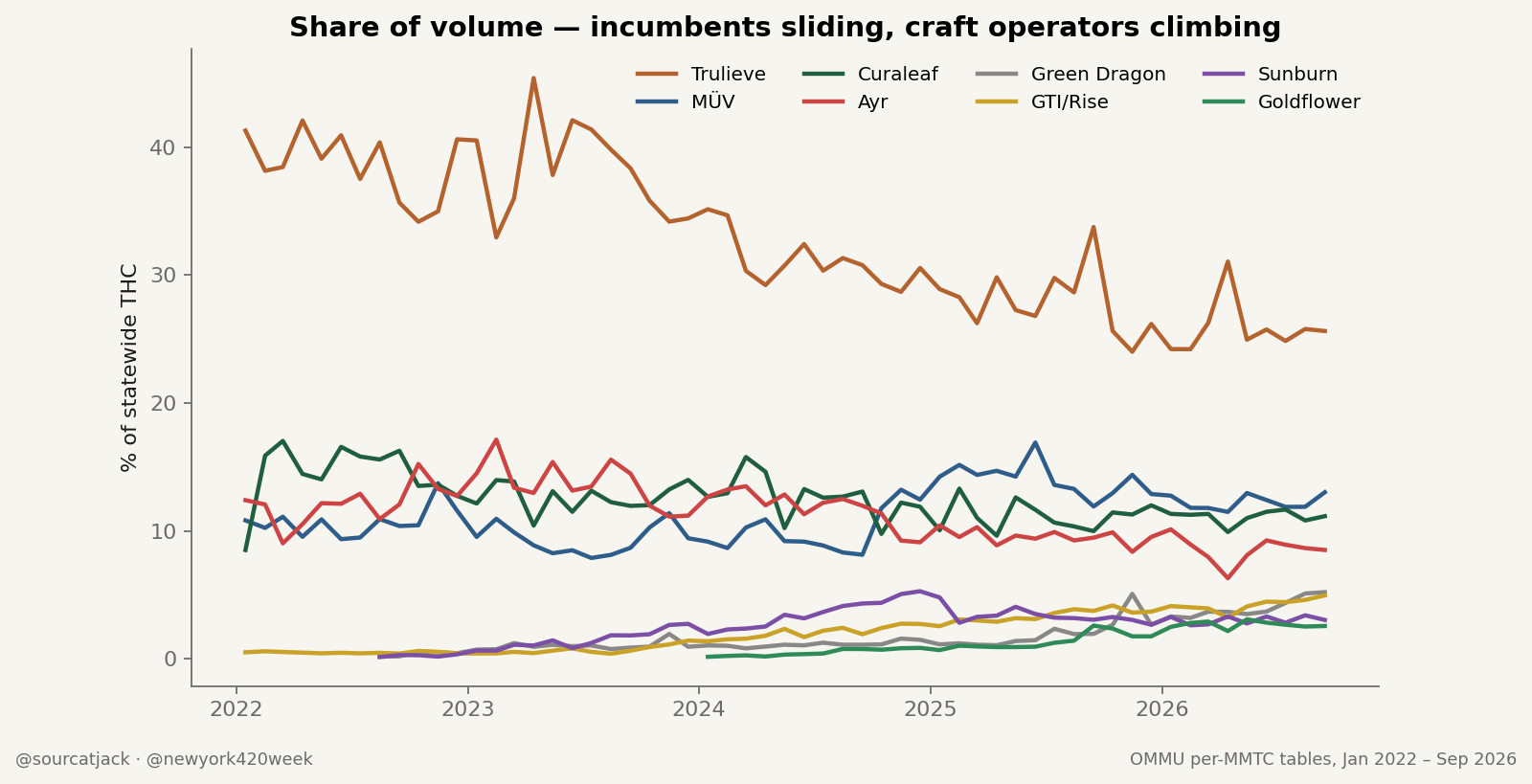
In January 2026, Vireo Growth had no Florida stores. It bought Eaze — and with it Green Dragon's 41 stores — in April. It has agreed to acquire FLUENT (33 stores, closing in the fourth quarter) and Planet 13 (34 stores). If all three close, a Minnesota company will hold 108 Florida dispensaries and 12.4% of statewide volume without opening a single new store.
That is the second-largest footprint in the state, assembled from three chains in nine months, two of which were financially distressed. Whether Vireo can actually operate it — three different grows, three cultures, one integration — is a separate question from whether it can buy it.
Who owns the doors
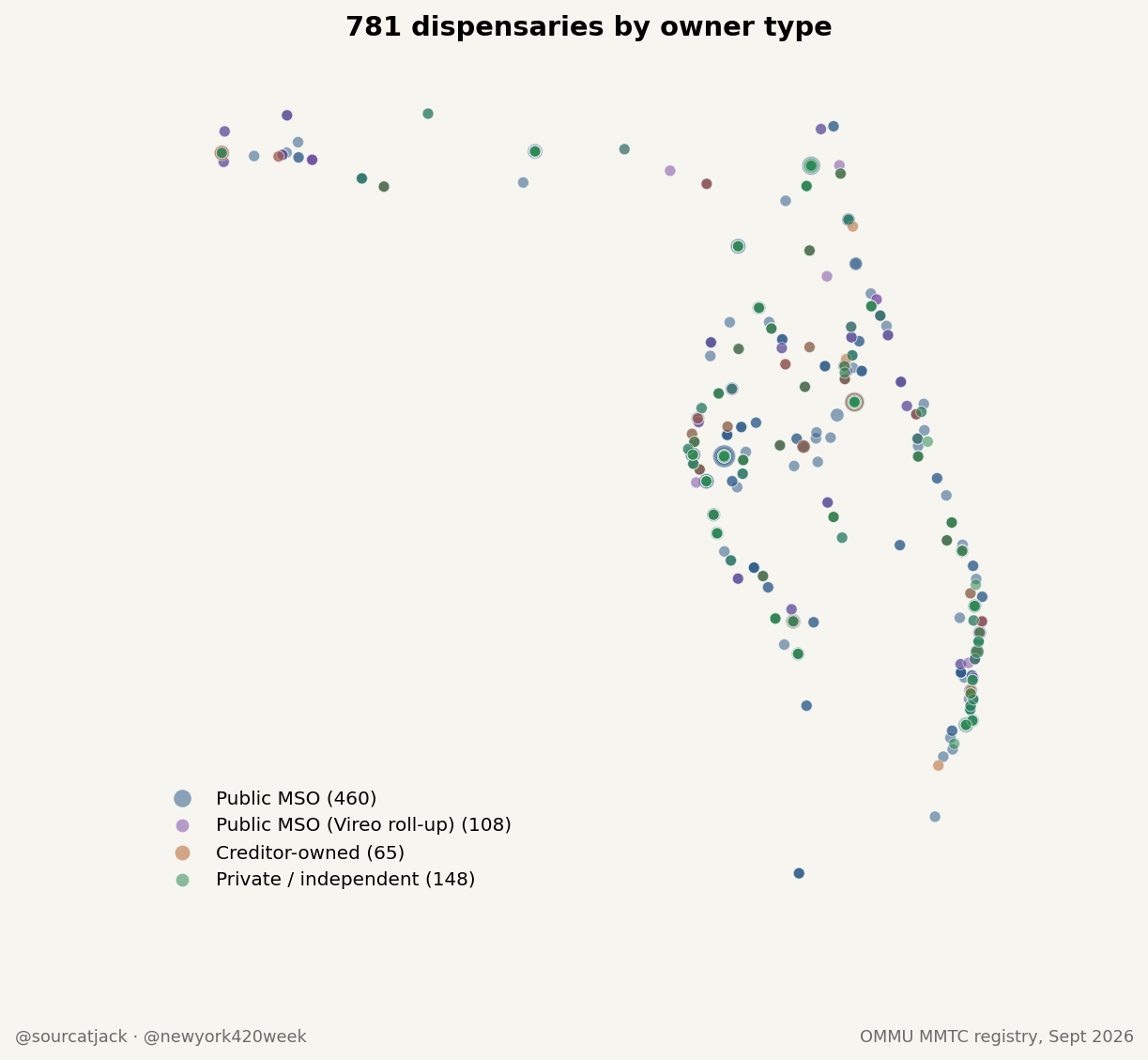
Of the 781 dispensing addresses in the state registry, 460 belong to publicly traded multi-state operators, 108 to the chains Vireo is absorbing, 65 to Ayr's creditors — who took the Florida business in June after the parent liquidated in Canada — and just 148 to independents.
A note on the counting: these buckets group stores by who owns them, and Vireo and Planet 13 are publicly traded in their own right, so “publicly traded” here means the seven established multi-state operators rather than every listed company. Our companion piece on out-of-state money groups the same stores by where the owner is from; its 516 already contains Green Dragon’s 41 and Planet 13’s 34, so that figure and Vireo’s 108 overlap by 75 stores and cannot be added together.
The footprint follows population: dense along the I-4 corridor from Tampa to Orlando, thick down the southeast coast from Palm Beach to Miami, clustered around Fort Myers and Naples, and thin across the Panhandle and the interior farm counties.
Four-fifths of Florida's cannabis retail is owned by public companies or their creditors. Almost all of the growth in sales per store is happening in the other fifth.
What to watch
Whether Vireo can run what it has bought. Whether Goldflower's new grow lands — it is adding stores faster than almost anyone while posting top-five per-store volume. Whether Surterra and FLUENT can keep their own shelves stocked after cutting cultivation. The Cookies ownership dispute, which has nineteen stores in play. And twenty-two brand-new licensees, none of which has opened a store, all of which must request dispensing authorisation within a year.
Methodology: volume, store counts and sales-per-store from the OMMU weekly dispensation table for September 5–11, 2026, with the per-company series built from all 245 weekly tables since January 2022. Store addresses from the OMMU MMTC registry (781 locations; the weekly table reported 779). Cultivation footprints and brand rosters from company filings, press releases and trade-press reporting — several operators disclose no capacity figure, and those are marked as such rather than estimated. "Sales" means dispensed milligrams of THC; Florida does not publish dollar sales. By Greg Silverstein · @sourcatjack · @newyork420week.