Research /Research
Twenty-Two Florida Counties Have No Dispensary At All
781 stores, 166 cities, and one company leading all nine regions of the state. A map of who actually owns Florida cannabis — and where the map simply stops.
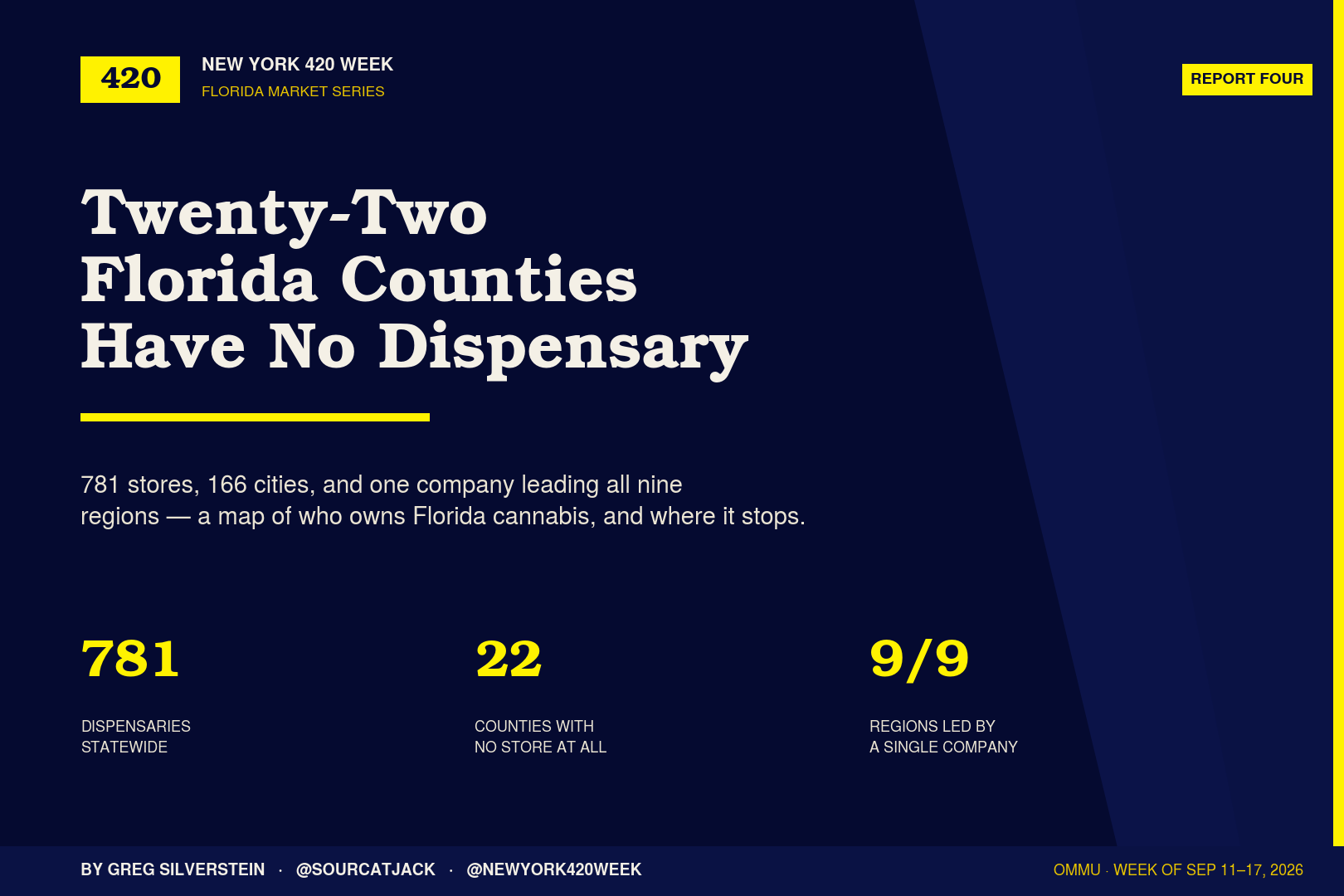
Florida has 781 licensed cannabis dispensaries. It also has 22 counties where you cannot buy legal cannabis at all.
Not "a limited selection." Not "one store on the edge of town." None. Baker, Bradford, Calhoun, DeSoto, Dixie, Franklin, Gadsden, Gilchrist, Glades, Gulf, Hamilton, Hardee, Hendry, Holmes, Jefferson, Lafayette, Levy, Liberty, Sumter, Taylor, Union, Washington — a third of the state’s counties, with a combined retail footprint of zero.
Sumter County is the one that should stop you. It contains The Villages, one of the largest retirement communities in the United States, in a state where the medical programme skews heavily older. It has no dispensary.
The market is 45 counties wide
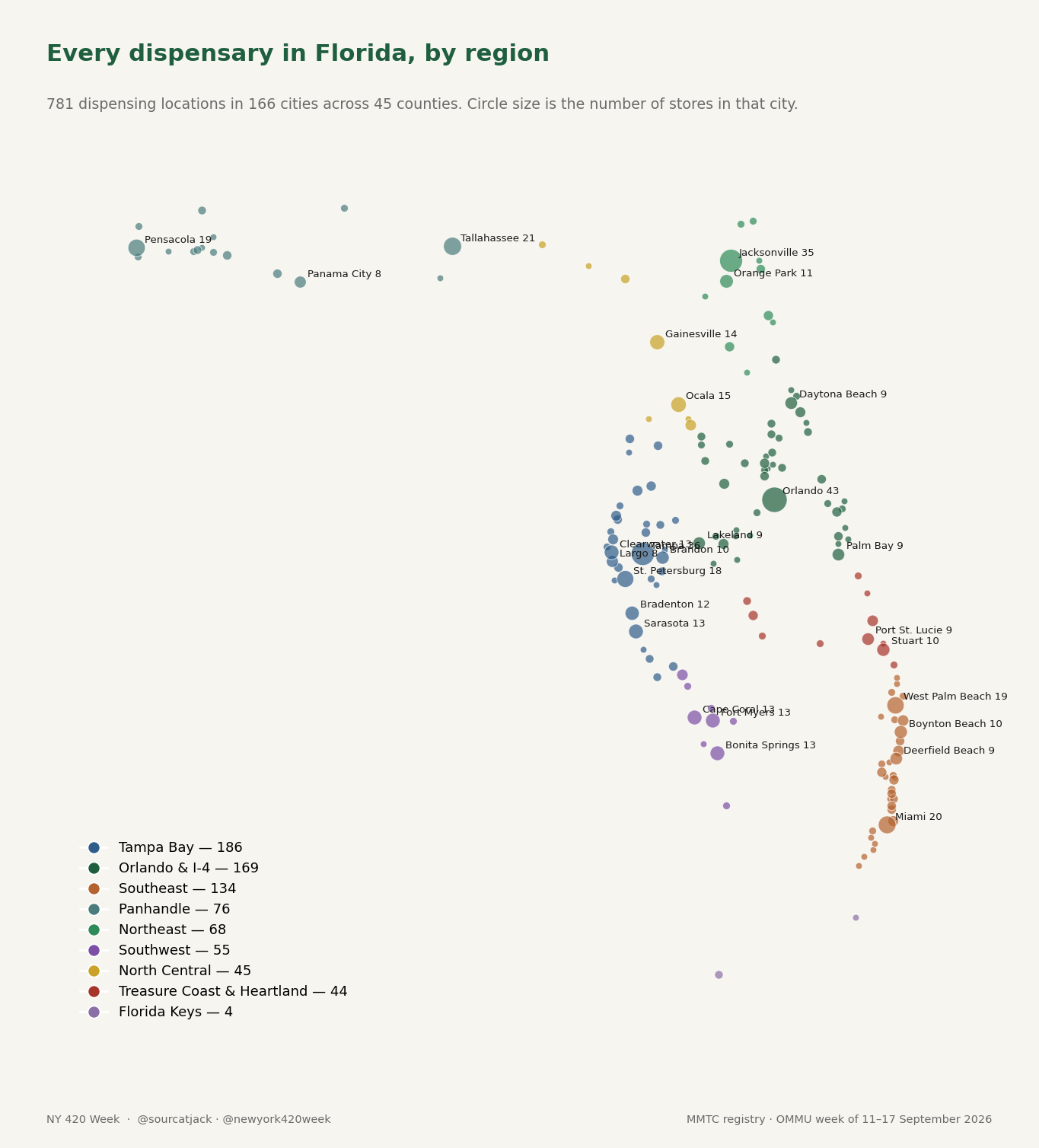
Plot all 781 locations and Florida’s retail market draws its own shape: a dense spine along the I-4 corridor from Tampa through Orlando to Daytona, a long chain down the southeast coast from Palm Beach to Miami, a Gulf-side run from Clearwater to Naples, and then — almost nothing across the interior and the Big Bend.
The whole industry fits into 45 counties and 166 cities. Three regions hold 63% of it.
| Region | Stores | Counties | Operators | Top three hold |
|---|---|---|---|---|
| Tampa Bay | 186 | 7 | 21 | 46% |
| Orlando & I-4 | 169 | 8 | 22 | 45% |
| Southeast | 134 | 3 | 19 | 43% |
| Panhandle | 76 | 8 | 18 | 41% |
| Northeast | 68 | 5 | 21 | 37% |
| Southwest | 55 | 3 | 17 | 44% |
| North Central | 45 | 5 | 18 | 38% |
| Treasure Coast & Heartland | 44 | 5 | 16 | 50% |
| Florida Keys | 4 | 1 | 3 | 100% |
Trulieve leads all nine
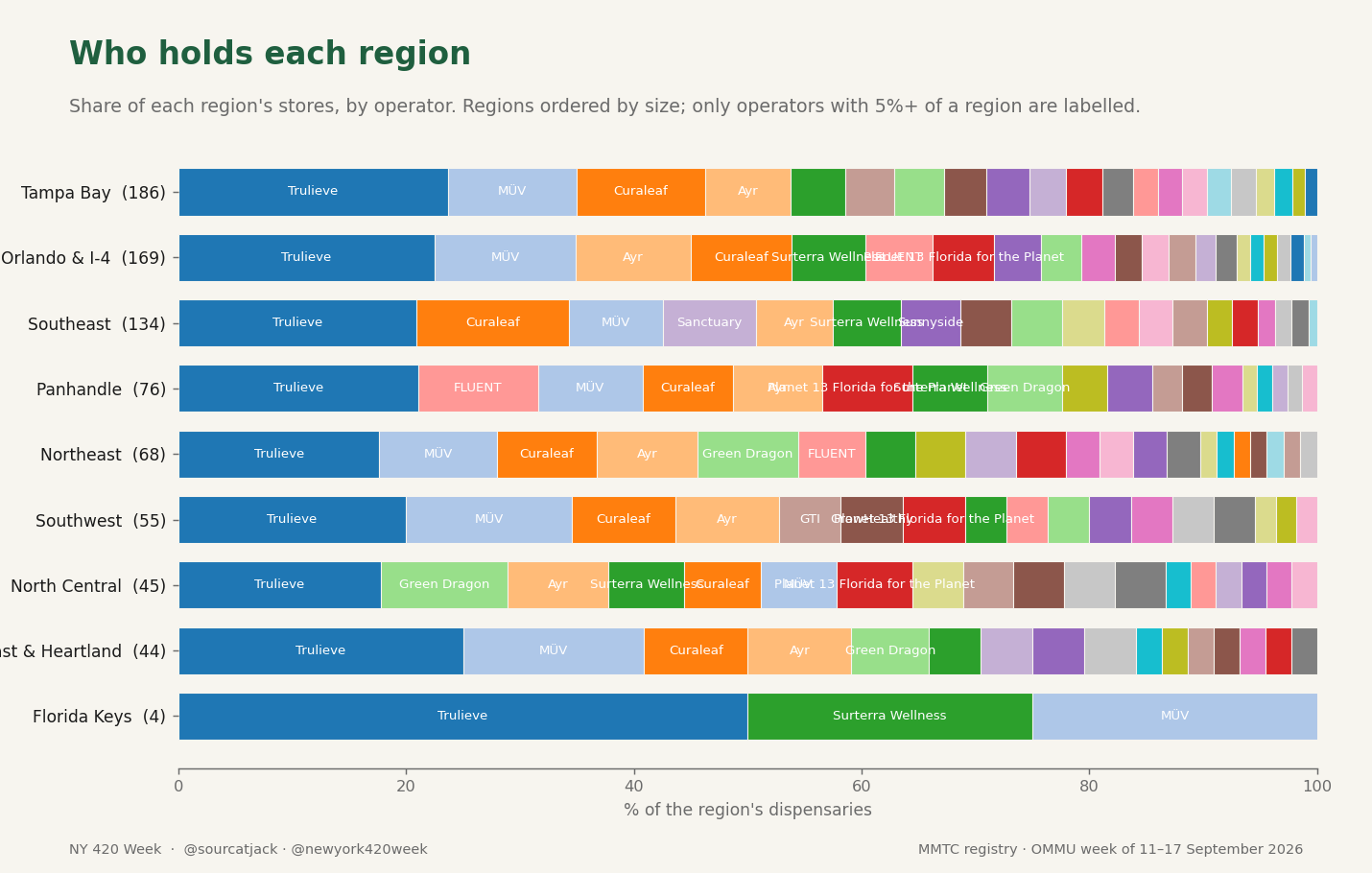
There is no region of Florida where Trulieve is not the largest operator. Tampa Bay, 44 stores. Orlando and the I-4 corridor, 38. The Southeast, 28. The Panhandle, 16. Even the Keys, where the entire market is four stores, two of them Trulieve’s.
That is an unusual thing to be able to write about any retail category. National chains normally have holes — a region where a regional player got there first and held it. Trulieve does not have one.
What changes between regions is everything behind it. In Tampa Bay, MÜV and Curaleaf are tied for second at 21 stores each. In the Northeast it is MÜV at 7 and Curaleaf at 6, in a region where 21 different operators compete for 68 stores — the least concentrated market in the state, with the top three holding just 37%.
At the other end, the Treasure Coast and Heartland is the tightest mainland region: three operators hold half of its 44 stores.
The counties that carry it
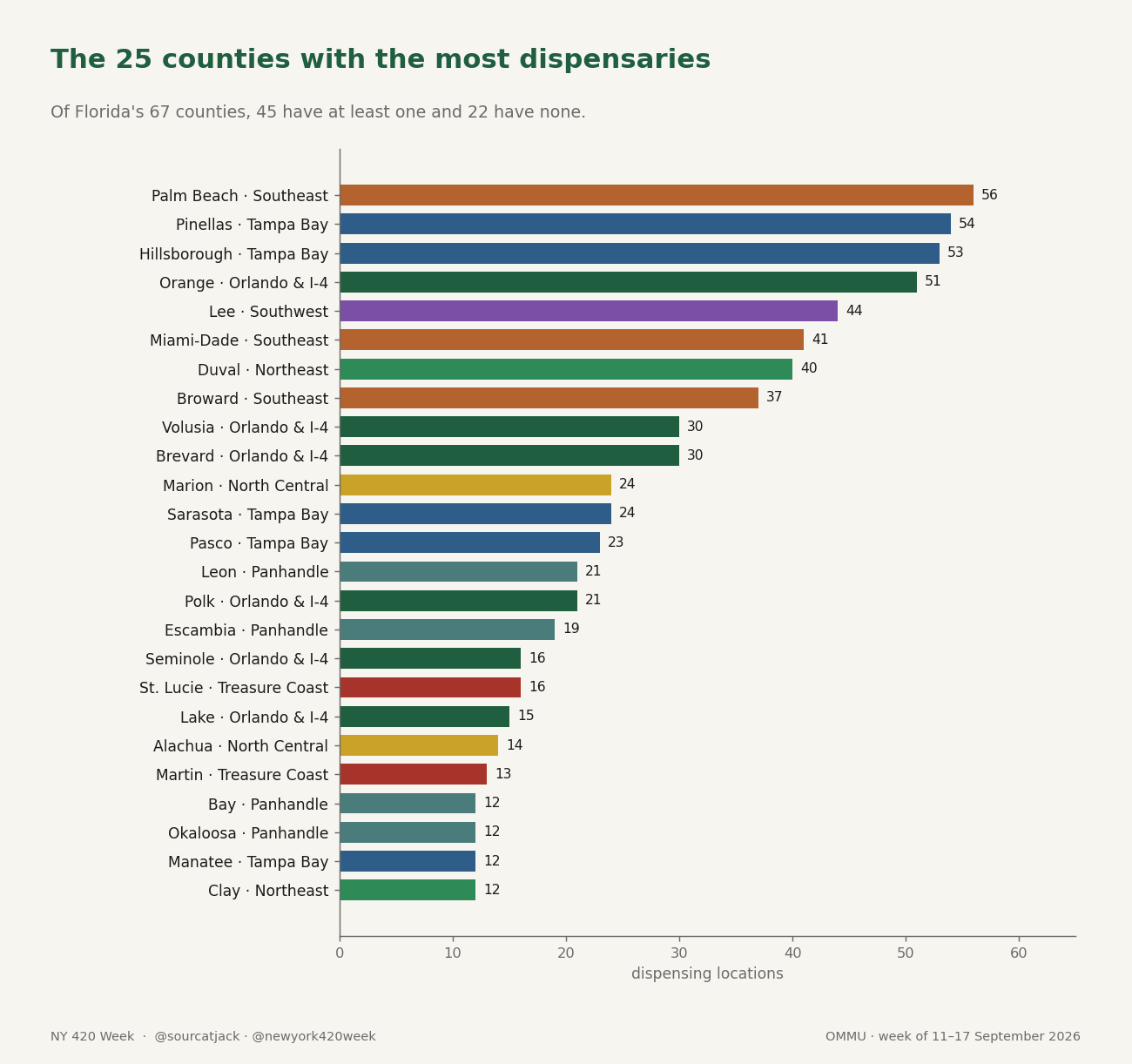
Palm Beach is the single biggest county market at 56 stores, ahead of Pinellas at 54 and Hillsborough at 53. Orange has 51, Lee 44, Miami-Dade 41.
Miami-Dade at 41 is worth a second look. It is Florida’s most populous county by a wide margin and it sits sixth. Palm Beach, with roughly half the population, has 15 more stores.
Two cities are carrying far more than their size
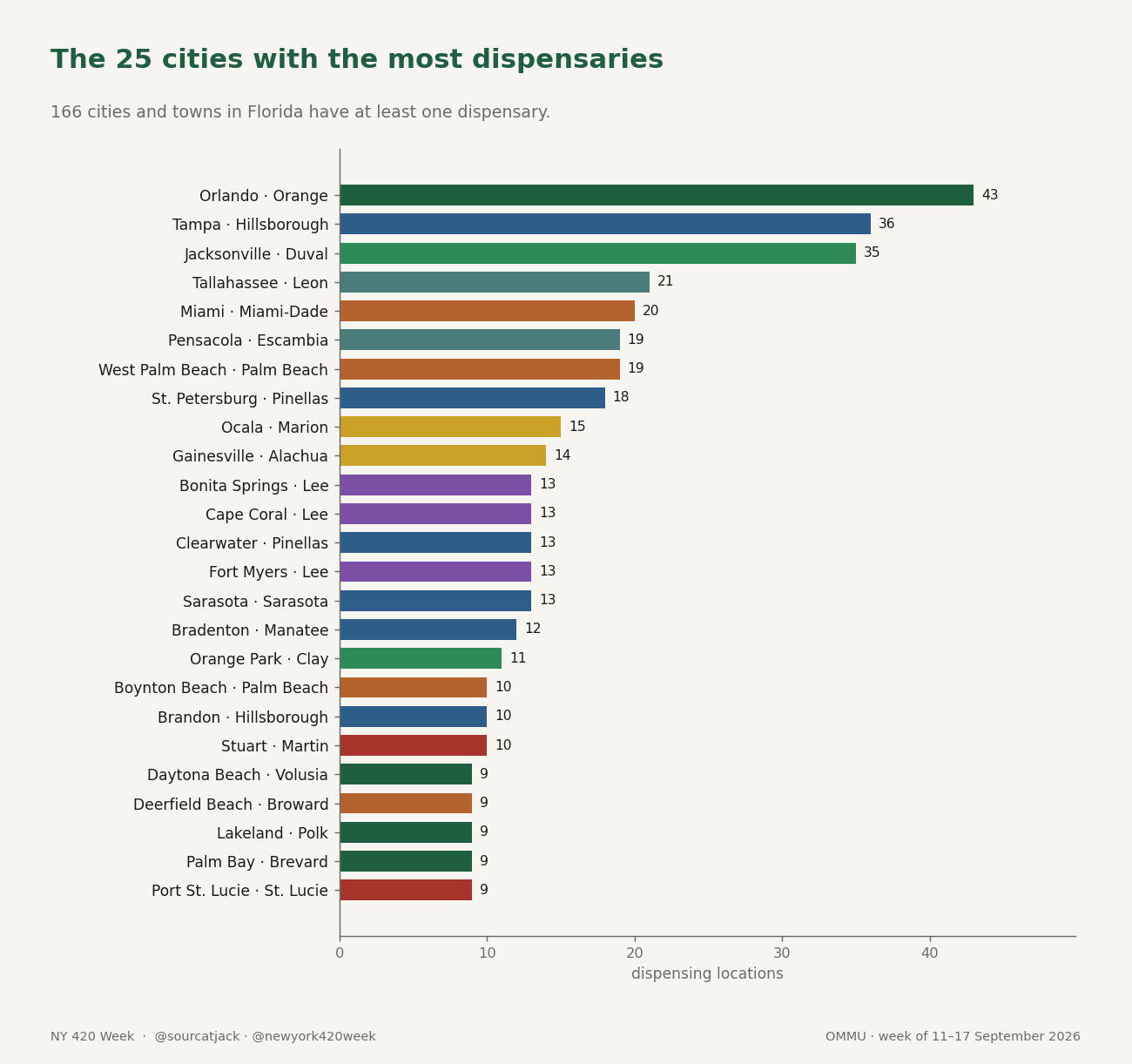
Orlando leads all cities at 43 dispensaries, then Tampa at 36 and Jacksonville at 35 — the three biggest metros, in order, no surprise.
Then it gets strange. Tallahassee has 21 dispensaries. More than Miami. More than St. Petersburg. Tallahassee is Florida’s seventh-largest city and it has the fourth-largest dispensary count in the state, which makes more sense once you remember that Trulieve was founded in Quincy, twenty miles west, and built its first grow there.
Pensacola has 19, tied with West Palm Beach. Pensacola is not a large market. It is, however, the far western anchor of a Panhandle that is otherwise thin — 76 stores spread across eight counties and several hundred miles.
Sidebar: which doors actually sell
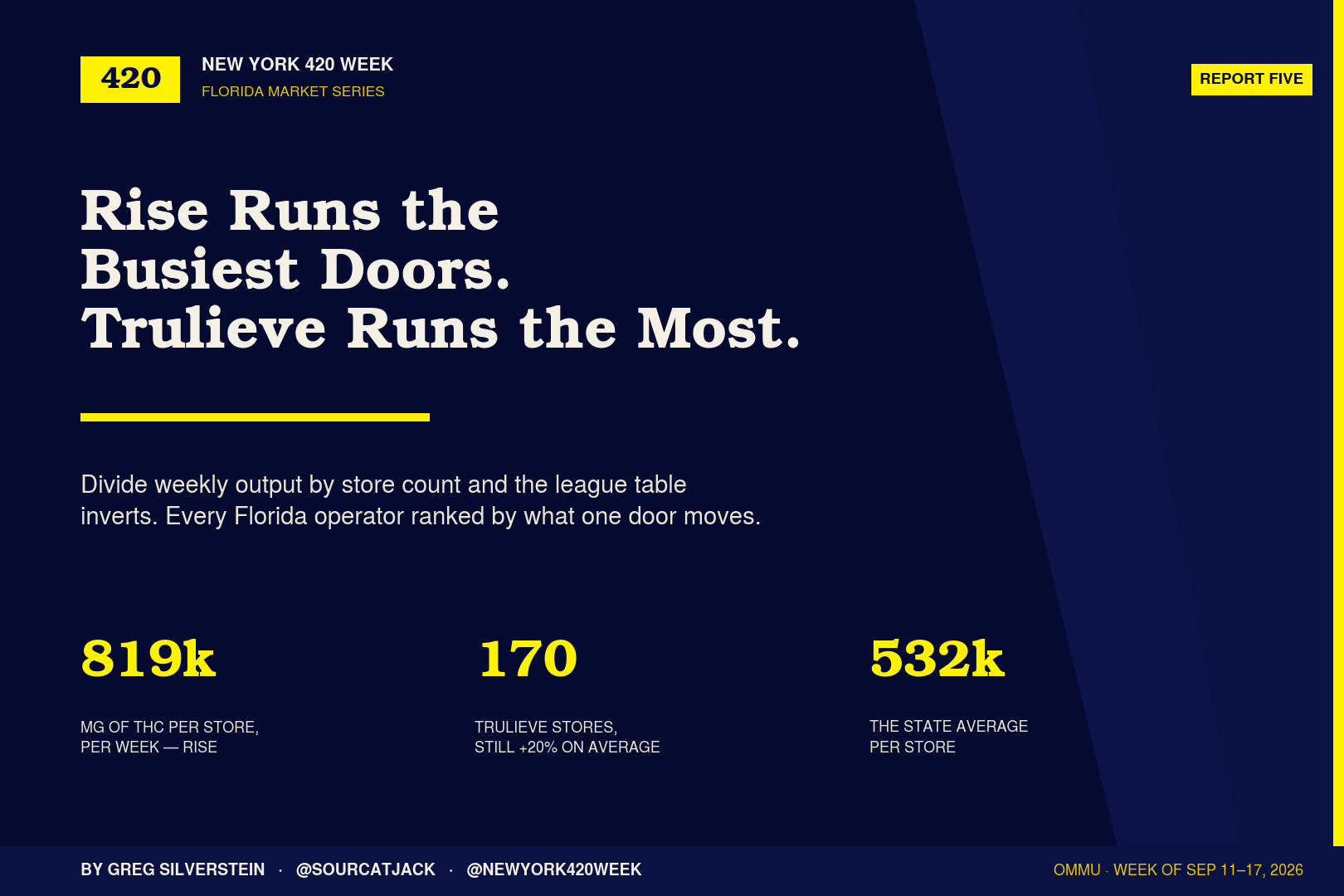
Store counts are a map of intent. What moves through those doors is a different measure, and it inverts the ranking.
| Operator | Stores | mg THC per store | oz flower per store |
|---|---|---|---|
| GTI / Rise | 25 | 818,966 | 194.2 |
| Sunburn | 15 | 812,922 | 205.2 |
| Goldflower | 16 | 715,201 | 156.8 |
| Trulieve | 170 | 637,357 | 299.6 |
| FLUENT | 33 | 623,436 | 142.1 |
| Curaleaf | 78 | 601,023 | 210.2 |
| State average | — | 532,416 | 190.3 |
The three most productive operators in Florida run 56 stores between them — 7% of the state. Trulieve’s 637,357 mg per door at 170 locations is the genuinely difficult achievement on that table, but the busiest individual dispensaries in Florida belong to chains a fraction of its size.
What the empty half tells you
Twenty-two counties with no dispensary is not a gap in demand. It is a gap in economics.
Every Florida licence is vertically integrated — the same company has to cultivate, process and sell. That makes each new store a claim on a fixed supply of product, which means operators open where the patients already are and the rent pencils out. Rural counties lose that calculation every time.
Which is why the empty half of the map is unlikely to fill on its own. Twenty-two new licensees received paper in September 2026 and none has opened a store; when they do, they will be solving the same equation everyone else solved, and it points at the I-4 corridor and the coasts.
The patients in Liberty County will keep driving.
Methodology: dispensing locations, cities and counties from the OMMU MMTC registry at knowthefactsmmj.com/mmtc, read 22 September 2026. Weekly volumes and the 941,650 patient count from the OMMU update for 11–17 September 2026. The registry’s 781 locations reconcile exactly with the weekly table, and every operator’s store count matches the state’s figure line for line. Three county spellings and four duplicate city spellings in the source were normalised; one Clermont store filed under Orange County was moved to Lake, where Clermont sits. Regions are trade areas defined for this report, not a state administrative boundary. By Greg Silverstein · @sourcatjack · @newyork420week.