NJ’s Rule Set a $30 Cannabis Fee. Regulators Waived It.
The fee was built to rise as prices fell. Regulators waived it twice, because the legal market is splitting the same customers among ever more stores.
Watch the story

New Jersey's cannabis law included a fee meant to grow as the market matured: the cheaper cannabis got, the more cultivators would pay per ounce, with the money going to social equity programs.
Prices have fallen further than almost anyone expected. The fee has barely moved.
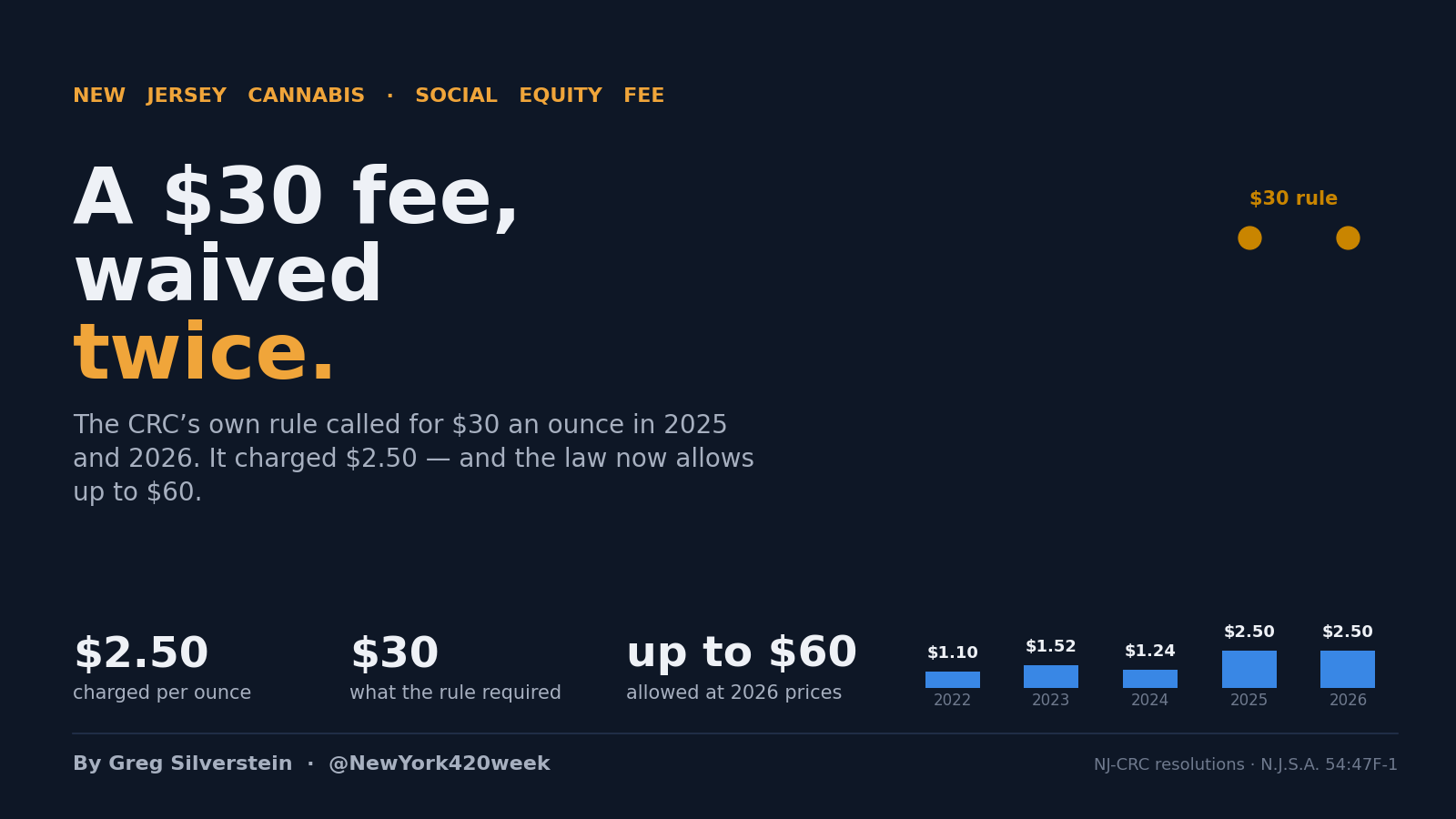
For 2025, the New Jersey Cannabis Regulatory Commission's (CRC) own rule set the Social Equity Excise Fee (SEEF) at $30 an ounce. The CRC waived the rule and charged $2.50. For 2026, the rule again called for $30. The CRC waived it again and kept $2.50. The fee brought in $10.97 million in 2025.
It's easy to read that as millions left on the table. The harder question is who would have paid, and what it would have done to a market that is still fighting for the same customers.
Watch the story
The customer the market hasn't won
Here is our read of the CRC's own numbers.
New Jersey's legal market is adding stores and brands much faster than it is adding customers. The number of dispensaries in the CRC's reports went from "more than 200" in early 2025 to "more than 315" by mid-2026. Statewide sales rose about 31% over the same stretch. Transactions grew about 26% in the year to June 2026. More shops are sharing a market that is growing, but not nearly as fast.
Plenty of New Jersey cannabis buyers never switched from their local plug. What would move them is simple:
- a better net price, meaning what they pay after tax, not the shelf price;
- quality they can afford and easily get to.
Everything the state does on tax and fees has to be judged against that. It's the biggest obstacle to growing the legal market, and with it the tax base.
That is the backdrop for the SEEF decisions.
What the fee is
The SEEF is charged when a licensed cultivator sells or transfers cannabis to another cannabis business. It's a flat amount per ounce. The statute sends the money to the CREAMM fund, to be appropriated "for investing in social equity programs."
The law, N.J.S.A. 54:47F-1, sets a higher ceiling at each lower price band:
| Average retail price of an ounce | The statute allows | The CRC's rule sets (usable flower) | The CRC's rule sets (trim for manufacturing) |
|---|---|---|---|
| $350 or more | up to $10 | $10 | $3 |
| $250 to $349.99 | up to $30 | $30 | $8 |
| $200 to $249.99 | up to $40 | $40 | $12 |
| Under $200 | up to $60 | $60 | $18 |
Sources: N.J.S.A. 54:47F-1(a)(2); N.J.A.C. 17:30-3.4(c), as quoted in CRC Resolutions 2024-298 and 2025-12-17-02.
The Legislature wrote "up to," which gives the CRC a ceiling, not a mandate. The CRC's 2021 rule turned those ceilings into fixed amounts ("shall be"). To charge less, the CRC has to waive its own rule.
Five years of rates
| Year | Fee per ounce | How it was set | Average ounce the CRC used |
|---|---|---|---|
| 2022 | $1.10 | Launch formula (1/3 of 1%) | $329.17 |
| 2023 | $1.52 | 1/3 of 1% (Res. 2022-48) | $455.56 (as of Aug 1, 2022) |
| 2024 | $1.24 | 1/3 of 1% (Res. 2023-142) | $373.00 (as of Sept 8, 2023) |
| 2025 | $2.50 | Rule waived; rule called for $30 (Res. 2024-298) | $330.68 (as of Aug 31, 2024) |
| 2026 | $2.50 | Rule waived; rule called for $30 (Res. 2025-12-17-02) | $251.06 (as of Sept 30, 2025) |
The two waivers
December 12, 2024 (Resolution 2024-298, the 2025 fee).
- The average ounce was $330.68, which is in the $30 band.
- The resolution says the Commission "determined that a waiver of N.J.A.C. 17:30-3.4(c) is necessary," and quotes the statute's "up to $30," adding "(emphasis added)."
- It set $2.50 for both flower and trim, and applied the fee to all Class 1 cultivators, "including cultivators of cannabis establishments that are 'vertically integrated.'"
- Chair Dianna Houenou made the motion and Commissioner Maria Del Cid-Kosso seconded. Del Cid-Kosso, Samuel Delgado, Houenou and Krista Nash voted yes. Commissioner Charles Barker abstained.
December 17, 2025 (Resolution 2025-12-17-02, the 2026 fee).
- The average ounce was $251.06: in the $30 band, but $1.06 above the line where the ceiling rises to $40.
- The resolution says: "N.J.A.C. 17:30-3.4(c) is hereby waived."
- Vice Chair Nash made the motion and Commissioner Amelia Mapp seconded. It passed 3–0 with Houenou; they were the only three commissioners seated.
The staff memo that went with the 2026 vote gives the only stated reason. It says the Commission chose the waiver "rather than raising the social equity excise fee from $2.50 per ounce to $30.00 per ounce," to "strike a balance that the New Jersey cannabis industry remains competitive, inclusive and still capable of supporting social equity goals." Neither resolution includes a revenue estimate or a price-impact analysis.
What the ceilings would mean, and why they're only ceilings
Because 2025's fee was a flat $2.50 on everything, the collections show the volume: $10,966,394 ÷ $2.50 = about 4.39 million ounces. That mixes flower with lower-rated trim, so the most we can say is a range:
| If the CRC had applied… | If every ounce were flower | If every ounce were trim |
|---|---|---|
| The $30 tier (what its rule required for 2025) | $131.6 million | $35.1 million |
| The $60 tier (this year's price band) | $263.2 million | $79.0 million |
| What it charged ($2.50) | $10.97 million collected |
Those figures assume the same ounces would still sell at a higher fee. That's the assumption the customer problem undercuts.
At $2.50, the fee equals about 9 cents a gram, roughly 1.4% of the $6.51 average adult-use gram in June 2026. At $30 an ounce it would equal about 16% of that retail price, and at $60 about a third. If a meaningful share of that reached the shelf, it would land on top of the 6.625% sales tax, which already takes a $6.51 gram to about $6.94 at the register. It would push legal prices back up just as they have become more competitive.
So the CRC's "competitive" reasoning has something to it, even if the Commission never showed its math. So does the other side of the argument. The fee exists to fund social equity programs, the statute clearly allows much more, and the CRC's own rule required it. Both years, the CRC chose price over revenue without publishing any analysis of the trade-off.
Where the 2027 fee lands
The statute bases each year's fee on the average price in "the calendar year next preceding." For 2027, that's 2026. (The CRC's rule and resolutions use the current year's price instead, measured part-way through the year.)
2026 has been the cheapest year yet:
- Adult-use flower averaged $6.865 a gram in the first half, about $192 to $195 an ounce. That is under $200, the band where the law allows up to $60.
- For the full-year average to climb back above $200, second-half prices would have to average about $7.25 to $7.42 a gram. That is higher than any month since January.
The CRC set the last two fees in December. Its board has changed since then: Harris Laufer became Chair in April 2026.
In February 2025, then-Gov. Phil Murphy's budget proposed raising the fee from $2.50 to $15 an ounce, as the New Jersey Monitor and other outlets reported. The fee is still $2.50.
Why it matters
Collections still tripled, from $3.48 million in 2024 to $10.97 million in 2025. But about $5.5 million of that $7.5 million increase came from the rate change, $1.24 to $2.50, not from the market. (That split assumes the same set of payers both years; the 2025 resolution may have widened it.)
The bigger lever on revenue isn't the rate. It's the size of the market the rate is charged on. A higher fee on a market that isn't adding customers is a short-term gain. A legal market that wins shoppers on net price and on affordable, easy-to-reach quality grows every revenue line at once: the SEEF, sales tax and local taxes.
Method and sources
- Fee rates, prices used and votes: CRC Resolutions 2022-48, 2023-142, 2024-298 and 2025-12-17-02; CRC staff memorandum for the December 17, 2025 meeting. Vote tables are on each resolution's certification page.
- Statute: N.J.S.A. 54:47F-1(a)(2) ("up to" tiers, prior-calendar-year basis, revenue to the CREAMM fund).
- Rule: N.J.A.C. 17:30-3.4(c).
- Collections and sales: CRC quarterly "Cannabis Sales Totals" (Treasury-certified). SEEF was $3,484,591 in 2024 and $10,966,394 in 2025.
- Prices, monthly sales, transactions, store counts: CRC board decks (Metrc). Store counts are the CRC's "more than N medicinal and recreational dispensaries" figures, so they are floors.
- Ceilings and after-tax price: our arithmetic. Implied ounces = 2025 SEEF ÷ $2.50. After-tax price = shelf price × 1.06625 (state sales tax only).
- Analysis: The view that the legal market is mostly redistributing existing customers, and that net price and affordable, accessible quality are its biggest barriers, is New York 420 Week's analysis of the CRC figures above. The CRC does not publish estimates of illicit-market sales.
- Governor's proposal: New Jersey Monitor, "Gov. Murphy wants to raise special cannabis tax from $2.50 to $15 an ounce" (Feb 2025).