NJ Cannabis Is 60% Cheaper. Tax Growth Fell to 2%.
Stores and brands keep multiplying and baskets are bigger, but New Jersey isn’t adding customers — and by late 2025 sales tax growth had nearly stalled.
Watch the story

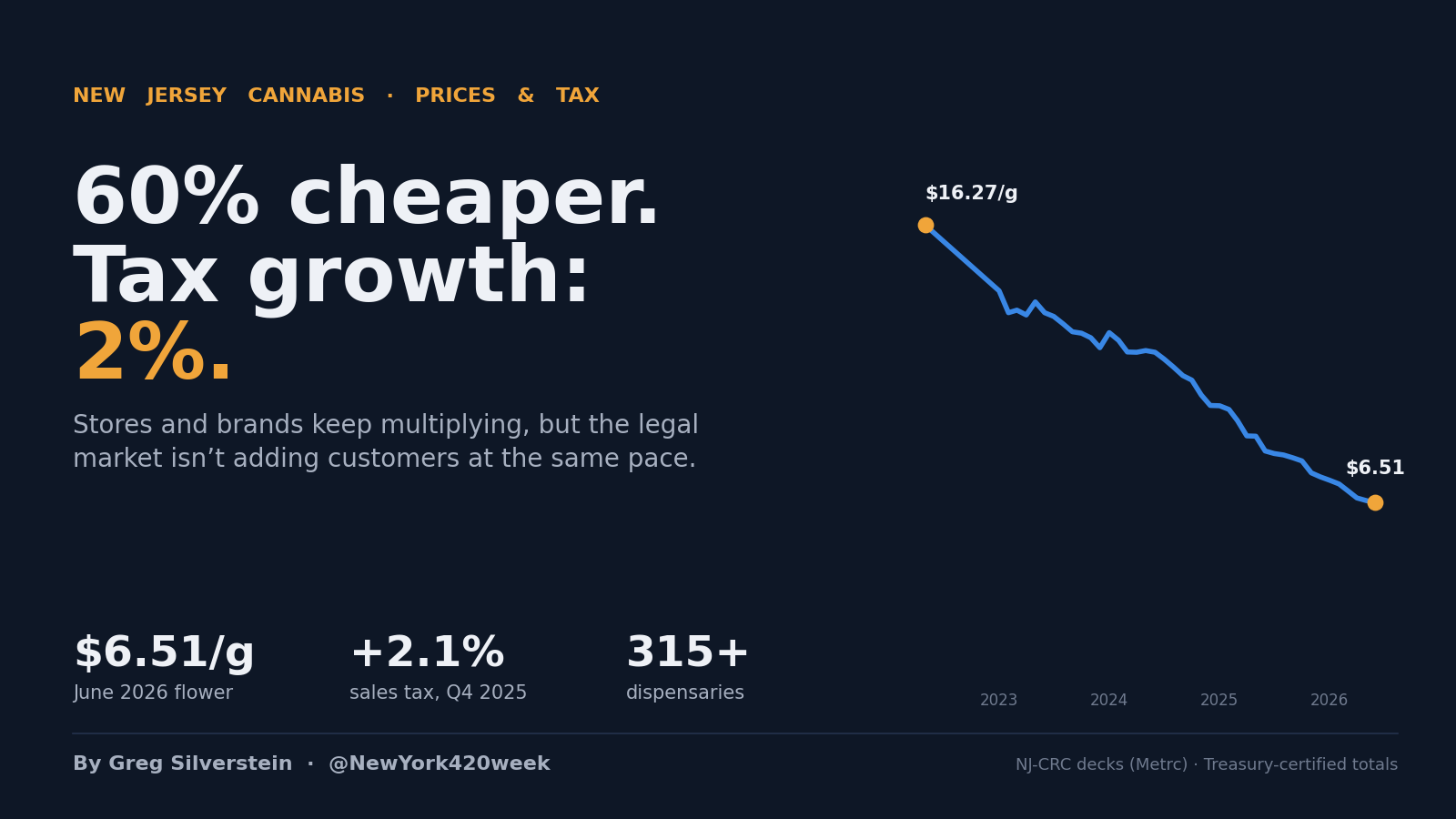
When New Jersey's adult-use market opened in the spring of 2022, a gram of flower averaged $16.27. In June 2026 it was $6.51. That's a 60% drop in four years, by the Cannabis Regulatory Commission's (CRC) own figures.
The CRC's message has been that the market is growing: in 2025, cannabis sales tax was up 11% and the Social Equity Excise Fee was up 215%. Both numbers are true. But look at where that growth came from and a different picture shows up. The legal market is getting bigger mostly by selling more to the customers it already has, and by spreading them across more stores. It isn't pulling in many new ones.
Watch the story
Our read: a crowded market chasing the same customers
Put the CRC's numbers side by side:
| Measure | Change | Period |
|---|---|---|
| Dispensaries (CRC count) | "more than 200" → "more than 315" | Feb 2025 deck → Jul 2026 deck |
| Monthly adult-use sales | +31% ($87.7M → $115.3M) | Jan 2025 → Jun 2026 |
| Transactions | about +26% | Jun 2025 → Jun 2026 |
| Implied volume (sales ÷ price) | about +57% | Jun 2025 → Jun 2026 |
| Price per gram | −21.8% | Jun 2025 → Jun 2026 |
The store count has grown faster than sales. Volume has grown about twice as fast as transactions. People are buying bigger baskets at lower prices, and the stores serving them keep multiplying.
That points to a market that is fairly fixed in size: the same pool of legal buyers is split among more shops and more brands. The customers who haven't switched are still buying from their local plug. For them, two things decide it:
- the net price, meaning what they actually pay once tax is added, not the number on the menu;
- whether they can get affordable, good-quality product that's easy to reach.
That is the biggest hurdle to growing both the legal market and the tax revenue that comes with it. The rest of this story is the evidence.
The price curve
| Month | Adult-use flower, per gram | After 6.625% sales tax | Change in shelf price |
|---|---|---|---|
| May 2022 (first full month) | $16.27 | $17.35 | — |
| January 2023 | $13.96 | $14.88 | |
| January 2024 | $12.49 | $13.32 | |
| January 2025 | $9.92 | $10.58 | |
| June 2026 (latest) | $6.51 | $6.94 | −60% from May 2022; −34% from January 2025 |
Source: CRC board decks (Metrc). The CRC revises this series often; we use the latest version of each month. After-tax column is our arithmetic, state sales tax only.
In February 2025, the CRC Chair's "Vision for Year 2030" set a goal of a "10% reduction in the average price for consumers." From January 2025's $9.92, that meant $8.93. Prices reached $8.86 by April 2025 and have fallen another 27% since.
Cheaper shelf prices are closing part of the gap. But the tax still sits on top of every legal purchase, and quality and access still vary from town to town.
Volume made up the difference, for now
| 2024 | 2025 | Change | |
|---|---|---|---|
| Adult-use sales (certified) | $1.000 billion | $1.118 billion | +11.8% |
| Average flower price per gram | $11.40 | $8.55 | −25.0% |
| Implied volume (sales ÷ price) | about +49% |
The Social Equity Excise Fee, a flat charge per ounce, offers a separate check on volume: about 2.81 million ounces in 2024 and 4.39 million in 2025, up 56%.
More product moving through the same stores is not the same thing as more customers. Each extra gram is taxed at a lower price than the year before.
The tax test
Sales tax is 6.625% of the retail price, so it follows dollars, not grams.
| Year | Adult-use sales | Sales & use tax | SEEF |
|---|---|---|---|
| 2023 | $681.2M | $41.9M | $3.19M |
| 2024 | $1,000.1M | $61.0M | $3.48M |
| 2025 | $1,118.0M | $67.5M | $10.97M |
Sales tax rose 10.6% in 2025, but the growth ran out quarter by quarter:
| Quarter | Sales tax | Change from a year earlier |
|---|---|---|
| Q4 2024 | $17.73M | +42.2% |
| Q1 2025 | $16.30M | +28.0% |
| Q2 2025 | $15.61M | +6.9% |
| Q3 2025 | $17.49M | +9.7% |
| Q4 2025 | $18.10M | +2.1% |
In the first two quarters of 2025, the state collected less sales tax than in the last quarter of 2024. In Q4 2025, sales tax grew 2.1% while certified sales grew 7.0%; the CRC hasn't explained the gap.
The 215% jump in the Social Equity Excise Fee is mostly a policy choice. The CRC doubled the rate from $1.24 to $2.50 an ounce. At the old rate, 2025 would have brought in about $5.4 million, up 56% rather than 215%. Read our story on the $30 fee the CRC waived twice.
When prices fall and the customer base doesn't grow much, tax revenue can only keep rising if each customer buys a lot more. That is starting to run out.
More stores, same customers
Statewide adult-use sales rose about 31% from January 2025 to June 2026. Over roughly the same period, the CRC's count of dispensaries went from "more than 200" to "more than 315," and Metrc listed 346 active adult-use retailer licenses in July 2026. The CRC's counts are floors, so exact per-store figures aren't possible. The direction is clear, though: the number of stores has grown faster than sales, so the average store is selling more product for less money.
The same is true upstream. Cultivators harvested about 1.56 million pounds (wet weight) in 2024, by the CRC's figures, and between 1.93 million and 2.05 million pounds in 2025, depending on which deck's version of each month is used. That's roughly 24% to 32% more. Growers are likely squeezed too: lower retail prices usually mean less per pound at wholesale, and the per-ounce fee doubled in 2025. The CRC doesn't publish wholesale prices.
New stores, new brands and new grows add supply and competition. On their own, they don't add customers.
The numbers keep moving
The CRC's own figures shift from one deck to the next:
- Harvest. For the 11 months that appear in both the May and July 2026 decks (June 2025 through April 2026), the July version is 10.7% lower: 1,651,371 pounds against 1,849,585. March 2026 went from 240,923 pounds to 218,553.
- A headline we couldn't reproduce. The May 2026 deck headlined "SALES UP 52%" from January 2023 to March 2026. The CRC's monthly figures show $47.9 million and $105.6 million, which is up about 120%.
- A projection that came in high. In February 2026 the CRC projected Q4 2025 sales tax at $18.94 million. The certified figure was $18.10 million, 4.4% lower.
Every version shows the same direction: prices down steeply, volume up. But the precise numbers keep changing.
Where this goes
New Jersey's first-half 2026 Metrc sales are up about 19% from a year earlier, so 2026 tax should still grow. Certified figures can come in below Metrc, though: in Q4 2025 they landed about 5% under the CRC's projection.
Our read: if prices keep falling around 20% a year and the customer base doesn't grow, sales tax growth will turn negative. Q4 2025 was already close to flat. Michigan may be a preview. After years of the same pattern (price collapse, volume boom), its annual cannabis sales fell in 2025 for the first time, the Detroit Metro Times reported.
The way out isn't more licenses or a bigger tax. It's winning the shoppers who still buy elsewhere: a competitive price at the register, after tax, and quality people can afford and get to.
Method and sources
- Prices, monthly sales, transactions, harvest, store counts: CRC public-meeting decks (Metrc data), February 2025 to September 2026. May 2022 price from the CRC's 2022 pricing slides ($16.27/g; $455.54/oz). Annual average prices are simple averages of the monthly figures.
- Certified sales, sales tax, SEEF: CRC "Cannabis Sales Totals" (Treasury-certified), 2022–2025.
- Implied volume and after-tax prices: our arithmetic (sales ÷ price; SEEF ÷ rate; shelf price × 1.06625). These are indexes, not measured weights.
- Analysis: The view that the legal market is mostly redistributing existing customers, and that net price and affordable, accessible quality are its biggest barriers, is New York 420 Week's analysis of the CRC figures above. The CRC does not publish estimates of illicit-market sales.
- Michigan: Detroit Metro Times (2026).
- Vision 2030: CRC February 18, 2025 deck, Chair's report.